

When my father died, grief didn’t hit me like a storm. It didn’t crash in, loud and impossible to ignore. It slipped quietly into my life, almost invisible at first, hiding in the small cracks of everyday moments. It was in the silence after my phone stopped ringing.
It was in the empty chair at the dining table, and in that pause just before I almost called him to tell him something trivial, only to remember he was gone. It was in the seconds when I reached for someone who no longer existed.
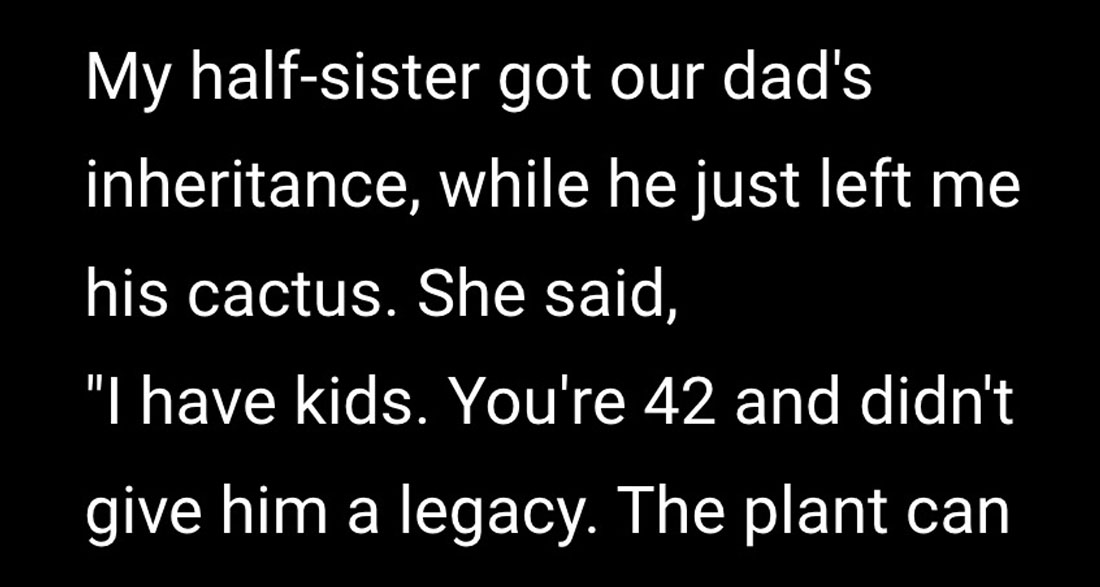
At the reading of his will, everything seemed normal—predictable, even. My half-sister got the house, the savings, the things people think of as a legacy: tangible proof that someone existed, measured in numbers and possessions.
I sat quietly, half-listening, half-floating somewhere else. The lawyer’s voice droned on, listing numbers and deeds, until finally he turned to me. His eyes were soft, unreadable. He paused. Then he said one line that didn’t belong in that sterile room of legal documents and serious faces.
“My father left you… his cactus,” the lawyer said.
I blinked. A cactus? That old, stubborn plant that had sat by the window in his study for as long as I could remember? The one that leaned toward the light, refusing to die no matter how many winters passed?
My half-sister laughed—not cruelly, just lightly, as if it was a joke. She had children, bills, responsibilities. She said, “You’re independent. You’re forty-two. You’ll be fine. The cactus… it’s symbolic, isn’t it?”
I didn’t argue. I didn’t explain what that plant had meant to me, what it had meant to him. I didn’t tell her how I had watched him stand beside it, lost in thought, one hand gently resting on the rim of the pot. I just nodded, accepted it, and carried it out carefully, as if it were made of glass.
That night, I put the cactus in the center of my kitchen table and stared at it for hours. Under the dim yellow light, it looked plain. Nothing special. But then I realized: it was the one thing he had kept close every day of his life.
He had sold furniture, donated clothes, given away tools—but that cactus had always stayed. He’d moved houses three times, and each time, it followed him, a quiet constant in his life.
My father wasn’t a man who said much about feelings. He showed them in small ways—a cup of tea waiting for me in the morning, a coat hung by the door on rainy days, a pause before answering, as if trying to speak more than words allowed. He built meaning quietly, through consistency.
And then I understood. The cactus wasn’t a joke. It wasn’t leftover. It was his way of saying, this is what stayed with me. Now it stays with you.
In the days that followed, I watched the plant the way he once had. I noticed how it leaned toward the morning sun, how tiny needles caught the dust and glimmered in the light. Memories returned: him saying once, “It doesn’t need much, but it never stops trying.” Simple words, but powerful.
Three days later, my half-sister called. Her voice was different—soft, uncertain. “I… maybe I want the cactus,” she said. “It meant more than I realized.” I told her no, gently. It wasn’t about keeping something from her, or about bitterness.
It was about holding something personal, a piece of him that belonged only to me.
Weeks went by, and the cactus became part of my daily routine. I watered it sparingly, just as he had taught me, feeling the soil with my fingers first. Sometimes I talked to it—small things, updates about work, the weather, nonsense—but comforting nonsense. The apartment felt less hollow with its quiet presence.
One Saturday, I decided to repot it. The old pot was cracked, worn. I bought a new terracotta pot, sandy soil, gloves for the sharp spines. As I lifted the cactus from its pot, something caught my eye.
Buried deep in the soil was a small, sealed envelope, browned at the edges but intact. My heart skipped a beat. I brushed off the dirt slowly, holding my breath.
Inside was a folded piece of paper. My father’s handwriting. Tight, deliberate, familiar. My hands shook as I unfolded it. He wrote about his mistakes, the ones he never found words for.
He said he was proud of me—not because of my achievements, but because I had built a life of kindness. Then he wrote about the cactus.
“It’s not a joke,” he said. “It’s a reminder that true strength is quiet, steady, and often overlooked.”
I sank to the floor, soil scattered around me, the note trembling in my hands. The apartment was so silent, I could hear my own breathing. I cried—the real kind that shakes you from the inside. Not polite funeral tears, but something raw and human.
The cactus wasn’t a leftover. It was a message, hidden in plain sight. He knew words didn’t come easily, so he spoke another way: a plant that survived harsh conditions, a letter buried in its roots—a final conversation waiting for me.
I never told my half-sister about the note. Not because I wanted secrets, but because it wasn’t part of inheritance or property. It was his words to me. I folded the paper carefully and placed it in a small wooden box by my bed.
From that day on, I cared for the cactus like he once did. It became a quiet companion. On bad days, I sat beside it, tracing the rough pot with my fingers. Sometimes I imagined him there, long ago, thinking quietly, lost in thought.
Seasons passed. One spring, a tiny pink bud appeared near the top—a surprise. I didn’t know cacti bloomed like that. When it opened fully, small and perfect, I felt it was a nod from him, a sign that he was still here, somehow.
People measure legacies in houses, savings, furniture. My half-sister has those things. I have something different—a piece of him, personal and real.
Six months later, when I moved apartments, the cactus was the last thing I packed, wrapped in towels. At the new place, I set it in the morning sunlight. For a moment, it looked just like it did in his study, wrapped in familiar light.
It just exists. No demands. No fuss. Quiet endurance. That’s the greatest lesson he ever gave me: survival itself can be an act of love.
Years went by. Friends called it “the inheritance” jokingly. I smiled, but it wasn’t a joke. On birthdays, I watered it carefully. When sunlight hit the spines, I sometimes imagined his shadow there, hands in pockets, thinking.
Late at night, I sometimes read the note again. The paper is softer now, worn, creased. His handwriting almost sounds like his voice—imperfect, sincere. Something so small carrying so much weight.
Grief never fully leaves. It changes shape. It’s woven into moments: watering the cactus, seeing the sun on its needles, remembering his hand resting beside it, never quite touching. It’s no longer pain. It’s memory, alive.
Occasionally, my half-sister and I talk about him. She mentions house repairs, old photos. We’ve softened over time. She doesn’t ask about the cactus anymore, but sometimes, I catch her looking at it when she visits. I think she understands, even without words.
The cactus still sits in the window, older, taller, spines sharper. It blooms rarely, but when it does, the fleeting pink flower reminds me of him: steady, quiet, full of subtle warmth. My father never taught lessons directly.
He taught through life itself. And the lesson he left me—hidden in a cactus and a letter—is simple: endure quietly. Grow in your own time. Hold on. Love quietly, even when words fail.
Now, every time I see the cactus in the light, I think of him—not as he was in his final years, frail and quiet, but as the man I knew as a child: steady, reserved, warm. He knew what he was doing when he left it to me.
He knew I’d find the note, read his words, and finally see him clearly—not as the distant father I once resented, but as a flawed, thoughtful man who, in his own way, said, I love you.
And maybe that’s what grief really is: learning to hear the love that was always there, even when it wasn’t spoken.