

Twenty years ago, I lost everything in one cruel December. I lost my baby. And only days later, I lost my husband too. What I didn’t know back then was that one small moment in a grocery store would quietly keep me alive—and come back to find me years later.
It has been two decades, yet I still remember that December like it never really ended.
The house was too quiet.
No baby cries.
No soft humming while rocking a chair.
Just the sharp, steady ticking of the kitchen clock, counting seconds like my pain didn’t matter.
I was five months pregnant when I lost my baby.
No warning signs.
No last gentle kicks.
No chance to say goodbye.
One moment, I was dreaming about names and tiny socks. The next, I was lying in a hospital bed under cold fluorescent lights, staring at the ceiling while a doctor spoke in a careful, gentle voice.
“I’m so sorry,” he said softly. “There’s nothing we could do.”
After that… nothing.
Just silence.
A crib that stayed empty.
I would stand in the nursery late at night, holding tiny onesies that still smelled new. Clothes that would never be worn. I had arranged stuffed animals on the rocking chair just a week before. A bear. A bunny. A lamb.
They stayed there for months, untouched.
The walls were painted a soft yellow. We chose that color together because my husband said it felt “happy.” After everything happened, those walls felt like they were mocking me every time I walked past the room.
And then, just like that, the crib stayed empty.
A week after the hospital, my husband packed a suitcase.
At first, I thought maybe he just needed space. Maybe he was going to stay with his brother for a few days. Maybe grief had hit him differently.
But he stood in the doorway, staring at the floor, unable to look at me.
“I need a family,” he said quietly. “And I don’t see one here anymore.”
The doctors had already told me the truth.
The damage was too severe.
My body couldn’t carry another pregnancy.
They said it gently, but the words still cut deep.
“I’m sorry,” one doctor said. “You won’t be able to have children.”
Three days later, my husband filed for divorce.
He said he wanted children.
Real children.
And just like that, he was gone too.
No one came for Christmas that year.
I stopped answering messages. I stopped picking up calls. Some days, I forced myself to eat toast just so I had enough strength to cry. I turned the shower on full blast so the neighbors wouldn’t hear me sobbing into my hands.
Grief doesn’t care how long you cry.
It doesn’t leave when it should.
It just settles into your bones and waits.
A few days before Christmas, I realized I hadn’t left the house in over a week.
There was no tea. No milk. No bread.
I didn’t even want to eat. I just wanted something warm to hold in my hands.
So I bundled up and walked to the corner grocery store.
Christmas music was playing too loudly. The aisles were packed with people carrying cookie trays, bottles of wine, wrapping paper, and decorations. Everyone looked like they belonged somewhere.
I stood in line with a cheap box of tea, staring at the floor, fighting tears.
Then I heard a small voice.
“Mommy, do you think Santa will bring me a doll this year? And candy?”
I looked up.
The little girl couldn’t have been older than five. Her hair was tied into a crooked ponytail, and a small scar crossed one cheek. She clung tightly to her mother’s coat like it was the only safe thing in the world.
Their cart held only milk and bread.
Her mother knelt down and stroked her hair, eyes filling with tears.
“Oh, sweetheart,” she said softly. “Santa wrote me a letter. He said he ran out of money this year.”
The girl’s face fell, but she didn’t cry.
She just nodded, like she already understood disappointment far too well.
Something inside me broke open.
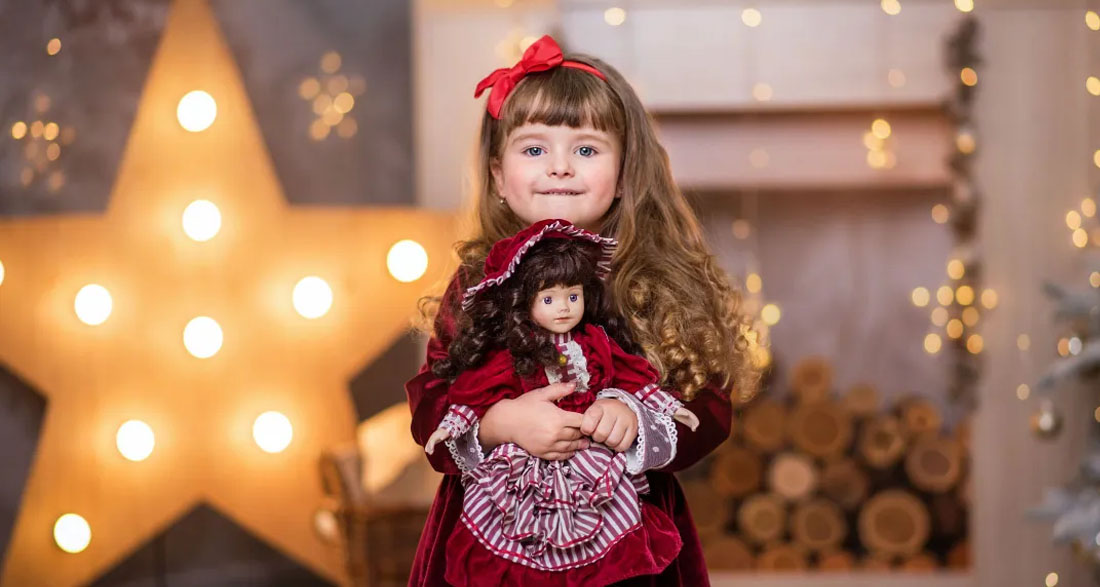
I left my tea on the counter and ran down the toy aisle. My heart was pounding so hard I could barely breathe. I grabbed the last doll on the shelf, candy canes, a small teddy bear, an apple, and an orange.
When I came back, they were gone.
I paid quickly, shoved the receipt into my purse, and ran outside. They were just about to cross the street.
“Hi!” I called out, breathless.
The mother turned, startled. The little girl stared at me with wide eyes.
I knelt on the cold pavement and smiled.
“I’m one of Santa’s elves,” I said. “We dress like regular people so no one knows.”
Her eyes grew even wider as I handed her the bags.
“Santa broke his piggy bank,” I whispered. “But he asked me to bring this to you. He said you’ve been very, very good this year.”
She screamed with joy and threw her arms around my neck so tightly I nearly lost my balance.
Her mother whispered, “Thank you.”
Just one word.
But in that moment, I could breathe again.
It was the smallest thing I’d ever done. And somehow, it saved me.
Years passed.
Twenty of them.
I never had another child. The doctors were right.
I tried dating, but nothing lasted. Some men left too soon. Others stayed without ever really seeing me.
I filled my life with books and quiet nights. Jobs that paid the bills but never filled the empty space inside me.
Christmas became quieter too. A small tree when I remembered. One gift to myself. A glass of wine if I felt brave enough to pretend.
But that little girl never left my mind.
Every December, I wondered if she still had that doll. If she remembered the stranger who pretended to be Santa’s elf.
Then, one Christmas Eve, as I sat down to dinner alone, I heard a knock on the door.
I wasn’t expecting anyone. Not even the mail.
I opened the door—and forgot how to breathe.
A young woman stood there, maybe twenty-five, wearing a red coat. The scar on her cheek was faint, but my heart recognized it instantly.
“I don’t know if you remember me,” she said softly. “But I remember you.”
“Oh my God,” I whispered. “It’s… you.”
She smiled. “I still have this scar. I got it falling off a tricycle when I was four.”
Her name was Mia.
She asked me to come with her. I didn’t know why, but I trusted her.
She drove me to a beautiful house glowing with Christmas lights. Upstairs, her mother lay in bed, frail but smiling.
“You saved me that night,” the woman said, squeezing my hand. “You saved us both.”
She told me how she had been broke. How Mia’s father had died the year before. How that one act of kindness made her believe life was still worth fighting for.
She started making dolls at home. From scraps. Sold a few. Then more.
“It grew,” she said softly. “Into this.”
She asked me to take over the business. To be part of their family.
“Please,” she said. “Don’t spend another Christmas alone.”
I cried harder than I had in years.
That night, we ate cookies and watched old movies. I finally felt like I belonged.
Her mother passed away two weeks later, peacefully.
At the funeral, I saw what kindness had built—a legacy.
And for the first time in twenty years, I didn’t feel like a ghost.
Kindness doesn’t just save the person who receives it.
It saves the one who gives it too.
Twenty years ago, I thought my life was over.
I was wrong.
Sometimes, the smallest act of love comes back as a second chance—disguised as a knock on the door.