

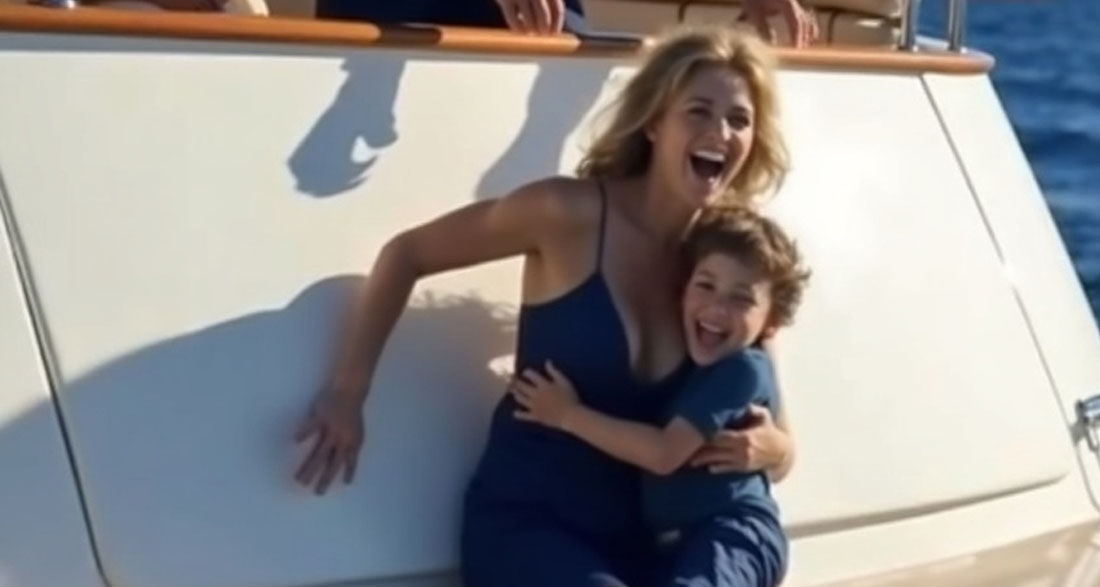
The night smelled like salt and expensive polished wood—the kind of clean, perfect luxury my parents adored. The yacht slid across the dark Atlantic like a quiet knife, its golden lights glowing softly above the endless black water. We were twenty miles off the Boston coast, surrounded by nothing but sea and sky.
I stood near the railing with my five‑year‑old son, Lucas, leaning against me. His small body was heavy with sleep, his cheek resting on my shoulder. The waves rose and fell gently below us. It all looked peaceful—too peaceful. I remember thinking how calm the night felt.
I had no idea how wrong that thought was.
We never heard them walking up behind us.
The shove came out of nowhere. Brutal. Fast. One second the deck was under my feet, solid and smooth. The next second the whole world spun, flipped, and disappeared.
I twisted in mid‑air, pure instinct kicking in, and I saw my mother’s face under the deck lights—calm, cold, and frighteningly familiar. She stared down at us as if we were strangers she barely tolerated.
Her voice cut through the wind, sharp and steady:
“You’ll vanish as if you never existed.”
Beside her, my husband leaned forward, his smile cruel and empty. The same mouth I used to kiss now shaped words that split my heart:
“Goodbye, worthless ones.”
There was no time to scream.
I grabbed Lucas with both arms, pulling him close as we fell. My only thought was: Don’t let him go. Don’t ever let him go.
The ocean hit us like a concrete wall. Ice‑cold water punched the air from my lungs. Darkness swallowed us instantly. Salt burned my mouth, my nose, my eyes. Waves twisted us like we were nothing. The ocean tried to rip Lucas from my arms, but I tightened my grip until my muscles screamed.
I forced us to the surface for one messy, choking breath—then another wave crashed over our heads.
Lucas didn’t scream. He didn’t fight. His tiny hands clung to my jacket exactly the way I had taught him during all those afternoons in the pool.
Hold tight. Don’t fight the water. Trust me.
The cold was vicious. It cut right through my clothes and sank into my bones. My muscles started cramping almost immediately. Above us, the yacht’s engine roared, then grew quieter.
They were leaving.
I pushed my head above the water again, coughing and gasping. The golden lights of the yacht were drifting away—shrinking, fading—like distant stars that didn’t care.
They didn’t slow down. They didn’t look back.
To them, we were already dead.
But I had survived worse than freezing water.
Before becoming a wife and mother, I worked in places where one mistake could kill you and trusting the wrong person could end your life. I learned how to stay calm when fear tried to drown me. That version of myself—the one built by danger—was still inside me.
Drowning would not be our death.
Giving up would.
My fingers searched the inside lining of my jacket. I prayed it was still there.
It was.
A small emergency beacon, stitched into the seam years ago out of old habit. With shaking hands, barely able to feel my fingers, I activated it and prayed someone, somewhere, would pick up the signal.
After that, all I could do was float, kick when needed, and keep Lucas’s face out of the water.
Time meant nothing. The darkness stretched endlessly. Every minute felt like an hour. Every breath felt like a gift I wasn’t sure I’d keep.
I talked to Lucas even when the wind stole my words.
“Remember the red slide at the park?”
“We’ll have pancakes in the morning.”
“I’m right here. I’ve got you.”
At some point, my foot hit something hard. A rescue float—drifting alone in the wide sea. I don’t know which boat it came from, but it felt like a miracle.
With the last of my strength, I pulled Lucas and myself onto it. The plastic scraped my frozen skin, but it held our weight.
The night crept by slowly, painfully. I lay over Lucas, shielding him from the wind.
Finally, a thin gray line appeared on the horizon. Morning.
Then I heard it—an engine. A small vessel cutting through the mist, searchlights sweeping the water.
At first it passed us.
My heart almost stopped.
Then a beam of light swung back and hit the orange float.
Voices shouted.
The boat turned.
Hands pulled us aboard. Warm blankets wrapped around us. A woman leaned over me, her voice shaking.
“What’s your name? Can you hear me?”
Someone else checked Lucas, whispering, “He’s breathing—pulse is weak but steady!”
I wouldn’t let them take him from my arms until my body finally collapsed and everything went dark. Before losing consciousness, I whispered into my son’s ear:
“We are not the ones who vanish.”
When I woke up, I smelled antiseptic and new linens. For a moment I didn’t know where I was.
Then everything came back—the fall, the cold, the betrayal.
I bolted upright.
Lucas was in the bed beside mine, wrapped in blankets, breathing softly. Relief crashed into me so hard it made my hands shake. I touched his small hand. He stirred but didn’t wake.
By sunrise, the rescue team had already moved us to a safe house far from the public. Doctors checked us, gave us warm clothes, hot soup, silence.
Then I began to think.
They had planned it.
My mother.
My husband.
They had both pushed us into the ocean. On purpose.
More evidence arrived—an insurance policy taken out secretly, forged documents transferring my assets, quiet financial moves set up to look like the actions of grieving family members after a tragic accident.
My death was worth more to them than my life.
Something inside me hardened.
The woman they tried to murder in the Atlantic was gone. A colder, sharper version of me woke up again.
I didn’t tell Lucas the truth. He was five. He only needed to know we fell, we were rescued, and we were safe now.
By nightfall, my shock turned into something else:
Resolve.
They believed I was dead.
They cried on camera. They hugged each other in front of reporters. Flowers piled up outside the mansion. Neighbors spoke softly about the tragedy.
Behind closed doors, the money began to move through the channels they had set up.
I let them believe everything was going according to plan.
I monitored every system they had touched—bank accounts, emails, property transfers. My old skills came back naturally. Operating in the shadows was easy for me.
The first thing I did was hijack every screen in their mansion.
Three nights after the fall, they returned home. The house was dark and quiet.
Then the screams began.
Every screen flashed on.
TVs. Tablets. Phones. Security monitors.
All showing my face—dry, steady, alive.
Four words appeared:
I’m not gone yet.
My mother collapsed into a chair, trembling.
My husband backed away as if the screens were alive.
Their nightmare had begun.
Over the next days, their world cracked open.
A key offshore account froze.
A scheduled transfer failed.
A vital document vanished.
Audits started—anonymous tips.
Financial irregularities surfaced.
The press noticed their nervous behavior. Rumors spread.
Then came the messages I sent:
Time stamps.
Account numbers.
Dates only we knew.
Information from conversations they thought had died in the ocean.
They barely slept.
Their trust in each other splintered. Blame grew like rot between them.
One stormy night, my husband broke. He ran into a police station, terrified, begging for protection, ranting that someone was after him.
That was enough to pull threads loose.
Investigators revisited the yacht logs.
Crew members remembered odd details.
The timeline didn’t match.
Their story cracked.
Public sympathy shifted into suspicion.
Pressure tightened.
The forged transfer records were discovered.
Digital fingerprints connected to my husband.
He tried to blame my mother.
She denied everything—until confronted with recordings.
Their partnership shattered.
They were arrested within the same hour.
Cameras captured them in handcuffs.
The world gasped.
I watched the footage with steady eyes.
Finally, after the dust settled, I reclaimed my identity quietly—piece by piece—removing the digital “death” they had written for me.
Then Lucas and I left the safe house under new names. Far from the cold Atlantic. To a warm place where the sea was gentle and forgiving.
At night, when Lucas sleeps, I sometimes stand on the balcony listening to the waves. The memory of the fall still waits in my bones—the cold, the dark, the betrayal.
But one truth always rises above the rest:
They thought I would disappear.
They were wrong.
And now they live with that mistake every single day—behind prison walls, haunted by the woman they tried to erase and failed to destroy.