

Some evenings stay with you forever—not because of what you ate or where you went, but because something unexpected reached deep inside you and shifted something in your heart. That night was one of those evenings for me.
My wife and I were driving home after a long, exhausting day. The kind of day that drains every bit of energy from your body and leaves your thoughts heavy and slow.
The sun had already disappeared, and the sky had turned that dull blue-gray color that makes everything look worn out, including us. We were too tired to cook and too tired to talk much.
When we spotted a small roadside restaurant with flickering lights and just a few cars parked outside, we didn’t even discuss it. We just pulled in. All we wanted was something warm, something quiet, and a short pause before heading home.
Inside, the restaurant felt just as tired as we were. The paint on the walls had faded over time. The music played softly, but it sounded slightly off, like it had been replayed too many times.
A few diners sat at scattered tables, eating quietly, lost in their own thoughts. The air smelled like frying oil mixed with dish soap, the scent of a place that had worked hard all day and hadn’t quite caught its breath yet.
After a moment, our waitress came over. She looked young, maybe in her late twenties, but the dark circles under her eyes made her look older. She wore a polite smile, though it felt forced, like it had been used too many times already that day.
Her voice was soft and flat, almost mechanical. My wife ordered soup and a salad. I asked for coffee and something hot to eat. I didn’t even care what it was. We weren’t there for a great meal—we were there because we had nowhere else to rest for a moment.
The service was slow. Not terribly slow, but slow enough to notice. The kind of slow that tells you someone is trying hard, but everything around them is moving too fast. She dropped a spoon once and quickly apologized.
She forgot our bread and said “I’m sorry” at least three times when she remembered. She moved around like someone balancing on the edge—still standing, but barely.
My wife glanced at me a few times with that familiar look that said, This is taking forever, but neither of us spoke. We were too tired to complain.
We ate quietly. The food was fine. Not amazing, not bad. Just food. It did its job.
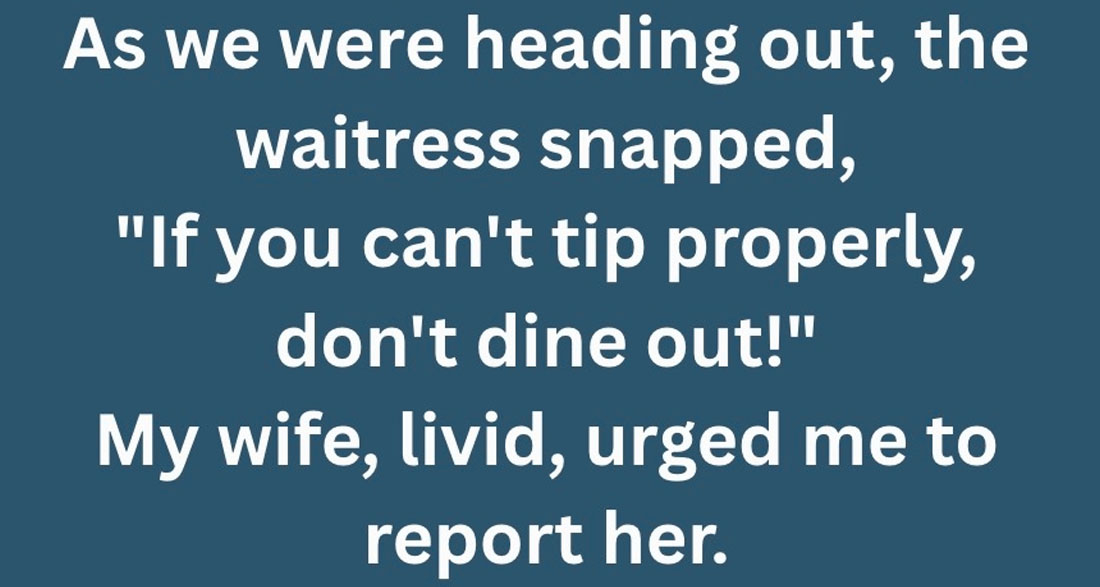
When the bill arrived, I looked at it without thinking, added a ten percent tip, and slid a few bills under the plate. It wasn’t generous or careless—it was automatic. Something I’d done a thousand times before.
We stood up, put on our coats, and headed toward the door, ready to leave the dim lights and heavy silence behind.
Then a sharp, shaking voice cut through the room.
“If you can’t tip properly, don’t dine out.”
It was her. The waitress.
I froze. My wife turned around instantly, her face turning red, anger flashing in her eyes. I could feel her ready to snap back, ready to defend us. A few other diners looked up, suddenly interested.
The room felt tight and uncomfortable. My own pride rose up fast, pushing me to respond, to explain, to make sure everyone knew we weren’t terrible people.
But then I really looked at the waitress.
Her hands were shaking as she stacked plates. Her eyes looked wet, like she was holding back tears. Her voice, though sharp, sounded cracked underneath. It didn’t sound cruel—it sounded exhausted.
I touched my wife’s arm and whispered, “Wait. Just trust me.”
She stared at me like I’d lost my mind, but she stayed quiet.
The manager was already walking toward us. He was an older man with tired eyes and a towel over his shoulder. His posture was stiff, like he was expecting a fight. I met his eyes and gave a small, calm smile.
“There’s no problem,” I said gently. “But I think your waitress is having a really hard night.”
He blinked, surprised. I explained what happened, speaking softly. I didn’t accuse. I didn’t complain. I told him I didn’t think she was rude—just overwhelmed. He let out a slow sigh and rubbed his forehead.
“She’s been working double shifts all week,” he said quietly. “Her mother’s sick. We’re short-staffed, and she refuses to take time off.”
His voice wasn’t defensive. It was tired. I nodded. Suddenly, everything made sense.
As we walked back through the dining area, she was wiping down a table with quick, nervous movements. She didn’t look up. I stopped at the tip jar near the counter and added more cash—more than I’d left on the table. I also folded the receipt and wrote a short note on the back.
It’s okay. You’re doing your best. Take care of yourself.
Then we left.
Outside, the air was cool and fresh, carrying the soft smell of rain that hadn’t fallen yet. My wife was quiet. I could tell she was trying to understand what had just happened. I didn’t feel proud or heroic. I just felt human—tired, calm, and strangely lighter than before.
We were almost at the car when we heard fast footsteps behind us.
“Wait!”
We turned around. The waitress stood there, her apron untied, her eyes filled with tears. She was breathing hard, like she’d run after us without thinking.
“I’m so sorry,” she said, her voice shaking. “I shouldn’t have said that. I’ve just had such a hard week, and when I saw the tip, I thought—” She stopped, unable to finish. She looked scared, embarrassed, completely raw.
Before I could speak, my wife stepped forward and gently placed a hand on her arm.
“It’s alright,” she said softly. “You don’t have to explain. We understand.”
The woman nodded, tears spilling down her cheeks. “Thank you,” she whispered.
We watched her walk back inside, shoulders slumped, apron strings trailing behind her. My wife looked at me, her eyes shiny.
“You were right,” she said quietly as we got into the car.
The drive home was silent at first. The headlights stretched across the empty road. Finally, my wife spoke.
“I thought you were just letting her be rude,” she admitted. “But it wasn’t about that at all.”
I nodded. “She just broke a little,” I said. “It could’ve been either of us on a different day.”
She leaned back in her seat. “I would’ve snapped back,” she said honestly. “I would’ve made a scene. But you didn’t.”
“I didn’t plan it,” I replied. “I just saw myself in her.”
That night stayed with us. Not because of the food or the words spoken, but because it reminded us that people carry invisible weights. People act sharp or cold not because they’re cruel, but because they’re tired, scared, or hurting.
In the days that followed, I thought about her often. I imagined her walking home, checking on her mother, crying quietly before sleep. I wondered if my note helped even a little. I hoped it did.
My wife changed too. When a cashier seemed short-tempered, she’d whisper, “Maybe she’s having one of those nights.” When a server made a mistake, she’d smile instead of sigh. We didn’t become perfect people—we just became more aware.
Weeks later, we passed that restaurant again. It was late afternoon, sunlight warming the sign. My wife suggested we stop.
Inside, the place felt brighter. Flowers sat on the counter. Cheerful music played. A young man greeted us. When I asked about the waitress, he smiled.
“Oh, Emma? She’s taking time off to care for her mom. She’s doing better.”
Something eased inside me.
As we drank our coffee, my wife smiled softly. “That night changed me,” she said. “You showed mercy.”
Maybe she was right. Mercy isn’t loud or dramatic. Sometimes it’s just choosing kindness when pride wants to fight.
Before leaving, I wrote another note on a napkin: The world is easier when we’re kind.
That night taught me something simple but powerful—empathy doesn’t take much. Just a pause. A breath. A choice.
And those are the evenings that stay with you.