

For as long as I can remember, my name felt like a coat that never quite fit. It was always a little too tight around the shoulders, a little too heavy in places I didn’t understand yet.
Before anyone asked me what I liked or what I dreamed about, they already thought they knew me. I was the garbage collector’s son.
Not my real name—the one my mother whispered when she kissed my forehead at night—but the name people used in their heads when they looked at me.
It clung to me like a shadow I couldn’t shake, in the hallways, the lunchroom, in the way teachers paused just a fraction too long before calling on me.
I didn’t even fully understand what it meant at first. I just knew it came with a certain look on people’s faces: a thin smile that didn’t reach their eyes, a polite distance colder than open dislike.
Other kids talked about their parents’ jobs like trophies. “My dad is a lawyer!” they’d say. “My mom’s a doctor!” They said it like the words themselves made them bigger, more important.
When someone asked about my parents, I learned very early to answer quickly and move on. “My mom works for the city,” I’d say, and then I’d ask about their dog, their new shoes, or the homework—anything to shift the spotlight away from me.
My mother hadn’t planned this life. She used to tell me about nursing school, about the long nights studying under harsh lights, about the smell of antiseptic and coffee in hospital corridors.
She liked the idea of helping people, of easing someone’s pain. But then my father fell. A stupid, ordinary accident on a construction site—the kind that flashes in the news for a day and disappears.
One moment he was alive, joking about what we’d have for dinner, the next moment he was gone.
Grief didn’t come gently. It crashed over us like a tidal wave, knocking down every plan, every dream, every sense of safety we had.
My mother took the first job she could find that paid enough to keep us alive. She didn’t complain. Not once. Every morning before the sun rose, she tied back her hair, pulled on gloves, and stepped into a world that smelled of diesel, garbage, and relentless hard work.
When she came home, her hands were rough and cracked, her shoulders aching like she’d carried the weight of the world. And yet she still cooked dinner, still asked about my day, still listened when I spoke about tiny, unimportant things.
I got very good at lying. “It was fine,” I’d say. “Nothing special.” I didn’t want to add even the smallest hurt to the pile she was already carrying.
School was its own battlefield. The jokes weren’t always loud. Most of the time, they were quiet, sharp, like little cuts you didn’t notice until they burned. Someone would wrinkle their nose as I walked past, as if I smelled bad.
Someone would leave a note on my desk: a stick figure next to a trash can, with a faint, mean laugh scrawled at the bottom. Teachers rarely saw it. I learned to make myself smaller. I sat in the back. I didn’t raise my hand. I became a master at disappearing—being present but unseen.
The library became my sanctuary. Cool, quiet, and judgment-free. Books didn’t care who my parents were. Numbers didn’t stare. I devoured old math textbooks, online lessons, anything I could get my hands on.
There was something beautiful about problems with clear answers, worlds that followed rules. If you did the work, you got the result. It was fair in a way life never was.
I started teaching myself things not in the curriculum. Algebra became calculus. Calculus became strange new equations with names I barely knew. I didn’t fully understand why I loved it so much.
I just knew that when I solved a problem, the rest of the world vanished. The hallway laughter, the looks, the labels—they all faded into nothing.
One day, Mr. Anderson noticed. My math teacher, thin with kind eyes, always pushing his glasses up his nose when he was thinking. He saw what I was doing. Instead of telling me to slow down, he asked, “What do you want to learn next?”
No one had ever asked me that before.
He gave me books, links, and problems that pushed me further than I’d ever gone. He treated me like someone with a future, not someone trapped by the past.
With his help, college stopped being a dream for other people. It became a possibility. We looked at programs, scholarships, forms that seemed written in a secret language, application fees that felt impossible—until we found waivers.
Essays that forced me to speak aloud truths I’d never spoken to anyone. I cried over my laptop late at night while she slept in the next room. Exhausted, broken, but still working. I didn’t want her to hear me. I didn’t want her to think she’d failed me.
Then came the letter.
Thick, official, heavier than it should have been. I held it, shaking, before opening it. At first, the words blurred: full scholarship. Housing. Acceptance. A future I had only dared imagine in quiet moments.
My mother cried when I told her. Loud, shaking sobs that startled us both. “I’m so proud of you,” she kept saying, over and over, as if saying it enough could make it true for herself too.
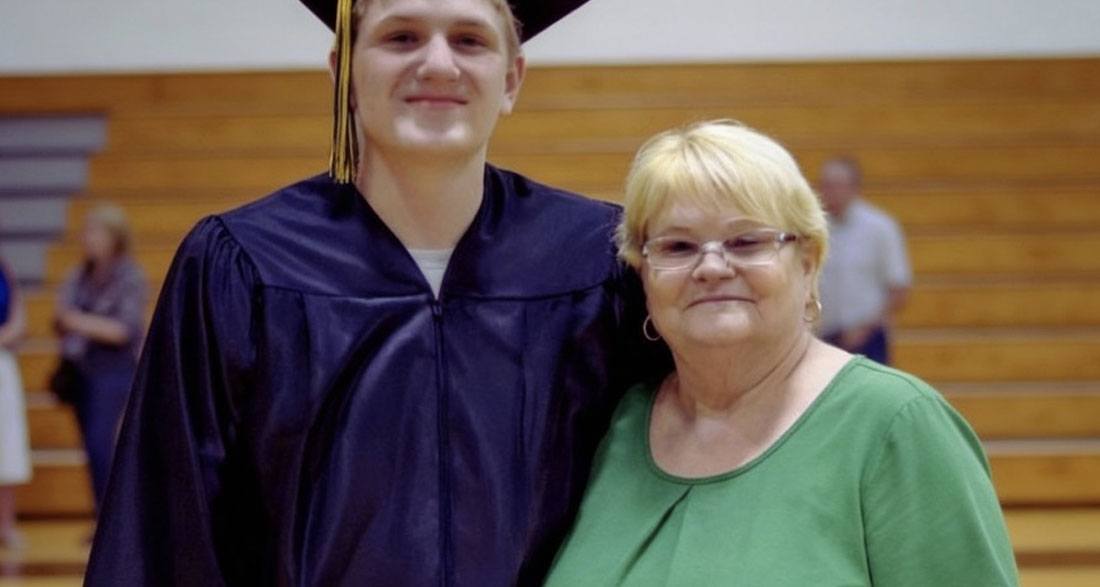
Graduation came faster than I expected. The gym buzzed with families, balloons, cameras, flowers, and the mingling scents of sweat and excitement. When they called my name as valedictorian, I felt like I was floating outside myself.
I stood at the podium, looking out at faces that had known me in pieces, if at all.
And I spoke.
I told them about the jokes, the labels, my mother and her uniform, and her strength. I talked about how easy it is to decide who someone is before you truly look. I said, “Dignity isn’t something a job gives you or takes away. It’s something you carry—or you don’t.”
The room was quiet, the kind of quiet I had never known before. When I finished, the applause felt distant, like it was underwater. The only thing real was my mother’s face—wet with tears, shining with joy, relief, and pride all at once.
That night, when she came home from work, her uniform still smelled of diesel and hard labor.
But it didn’t feel heavy anymore. It felt like proof of something strong, unbreakable, and deeply human. I held onto that feeling, letting it fill the spaces that used to be empty, carrying it with me into everything that came next.