

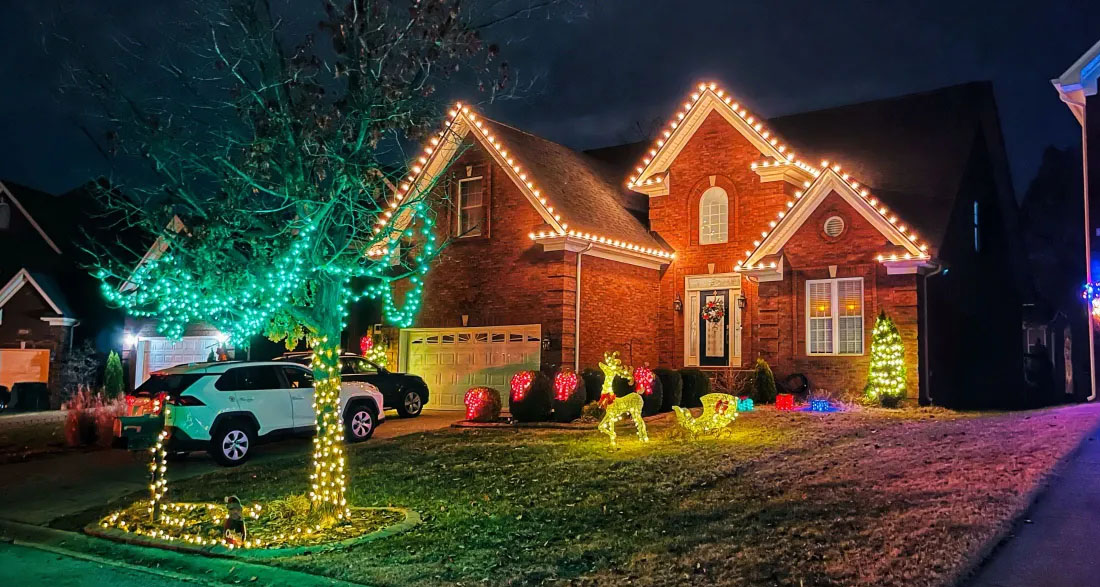
I’ve always believed you can tell how warm a home is just by looking at it from the street.
Not by how expensive it looks, or how perfect the decorations are, but by the feeling it gives off.
The kind of feeling that makes you slow your car down without even realizing it.
The kind of glow that whispers, Something good happens inside that house.
Our house had that glow.
Every December, my three kids and I turned our little yellow bungalow into what the neighbors lovingly called “the Christmas postcard.” We didn’t have fancy decorations or matching themes.
What we had were hand-tied garlands stretched across the porch rails, twinkling lights taped a little crooked on the windows, and an inflatable Santa waving proudly from the front lawn.
Our wooden reindeer sat near the mailbox like a loyal guard. It was painted with shaky brushstrokes, too much glitter, and uneven eyes. The glitter never stayed where it was supposed to. It ended up on the porch, on our clothes, and sometimes even in our hair.
Nothing was perfect.
But everything was made with love. And to me, that mattered more than anything.
My husband, Matt, used to laugh every year when we finished decorating. He would stand in the driveway, hands on his hips, shaking his head.
“It looks like the North Pole exploded out here,” he’d say, smiling.
He always said it like it was the best thing in the world.
After Matt passed away, the kids and I kept every tradition alive. We hung the same lights, tied the same garlands, and hosted the same hot cocoa nights. Christmas was when the house felt alive again. It was the one time of year when the silence didn’t creep into the corners.
It was when laughter filled the air, when the kitchen table was covered in glue sticks, paper scraps, and dried-on glitter. It was when grief loosened its grip just enough for joy to breathe again.
But this didn’t start with me as a mother. It started when I was a child.
When I was little, my mom played old Christmas records while my sister, Jillian, and I decorated the windows with tissue paper snowflakes. Mom’s snowflakes were always perfect. Mine were usually crooked, torn, or missing a piece.
Dad wrapped lights around the porch while I stood at the bottom of the ladder, holding the end of the string like it was the most important job in the world. Jillian stayed inside with Mom, tying bows and being praised for how “neat” and “careful” she was.
When everything was done, Dad would clap his hands and grin.
“You lit up the whole street, Amelia.”
I never forgot that.
Even now, decades later, I think I decorate for the same reason. Some part of me still wants the street to feel lit up. Still wants to feel like I matter.
That morning, it started with a strange silence.
Not a crash. Not shouting. Just the kind of silence that tells you something is wrong before you even see it.
I opened the front door with my youngest, Noah, on my hip.
And my heart dropped.
Everything was gone.
The lights were ripped from the roof and thrown into tangled piles on the lawn. Santa was slashed open, deflated, and half-buried in the flower bed. The wooden reindeer was snapped clean in two, lying beside the curb like it had been tossed aside without a second thought.
Our garlands—the ones tied with cinnamon sticks and red ribbon—were twisted, torn, and scattered like trash.
I couldn’t speak.
Owen and Lily stepped outside behind me. Owen’s face crumpled as he looked around.
“Mom… what happened to everything?”
Lily grabbed my hand tightly. Noah stared at the shredded Santa and whispered in a tiny, scared voice,
“Mom… is Santa dead?”
I stepped off the porch slowly, still hoping for a better explanation. Maybe teenagers had played a prank. Maybe the wind had been stronger than expected. Anything was better than believing someone had done this on purpose.
Then I saw it.
A small silver heart-shaped keychain lay in the grass near the broken reindeer. It caught the morning light just enough to sparkle.
I bent down and picked it up, my stomach tightening.
I knew exactly who it belonged to.
It was my sister Jillian’s.
She’d had it since college. I once teased her about it, and she laughed and said,
“It’s my lucky charm, Amelia. My safety net.”
I didn’t call the police. I didn’t need to.
“I’m going to fix this myself,” I whispered.
After distracting the kids with cartoons and chocolate cereal, I stood at Jillian’s door. She opened it wearing a burgundy velvet robe and perfect red lipstick, like nothing in the world was wrong.
“Amelia,” she said lightly. “You’re up early.”
I held the keychain up between us.
“This was in my yard, Jillian. Your lucky charm.”
Her eyes flicked to it.
“I must’ve dropped it,” she said smoothly. “When I stopped by with crackers for Owen.”
“Jillian,” I said quietly. “You destroyed my decorations, didn’t you?”
She paused. Then stepped aside.
“You should come in.”
Her house was spotless. White, silver, beige. It smelled like linen and eucalyptus. It looked beautiful… and cold.
“No one ever comes to my Christmas party,” she said suddenly. “You’ve noticed, haven’t you?”
“You send formal invitations,” I replied. “You hire decorators. But where’s the warmth, Jill? Where’s the mess?”
“I like elegance,” she said.
“I thought it would make me visible.”
Her voice cracked just slightly.
“Because I try,” she said. “Every year. And somehow, you always get the love.”
“You think people come for cookies and paper ornaments?” I asked.
“No,” she said. “They come because of you. You make people feel like they belong.”
“I never meant to take anything from you,” I whispered.
“I was always second-best,” she said softly.
That night, my kids made new decorations at the table. Paper stars. Foil snowflakes. A paper plate Santa.
When my parents arrived later, I told them the truth.
“I think we were too hard on Jillian,” I said. “She did everything right. And we didn’t always see her.”
Mom squeezed my hand.
“What do you want to do?” she asked.
I looked out the window at Jillian’s dark house.
“I think we show up for her.”
That night, we quietly decorated her porch. Ribbon. Lights. Paper stars.
On Christmas morning, Jillian stepped outside and froze.
Her shoulders dropped—not in sadness, but relief.
When we crossed the street with cinnamon rolls and cocoa, she opened the door before we knocked.
“I thought you hated me,” she whispered.
“No,” I said gently. “Now I understand.”
Sometimes the real Christmas miracle isn’t fixing what’s broken.
It’s seeing the pain someone’s been carrying…
and choosing love anyway.