

I had been working as an emergency physician at Saint Raphael Medical Center in Milwaukee for almost eight years. Eight years. Long enough to think I had seen it all. I had seen loss and panic, anger and relief, joy in every form.
I had watched people say goodbye, and I had watched people return from the edge. Over time, it made you feel steady, like nothing could shake you. You learned how to stand in the middle of someone else’s storm without letting it pull you in. That’s what I believed, at least.
I was wrong.
It was a Thursday night in early November. Nothing special about it. No holiday chaos, no massive accident, no bizarre weather. Just cold rain tapping on the windows, making the world outside look blurred, tired, and gray. I was five minutes from the end of my shift.
My body felt heavy with that quiet exhaustion that comes when you know the finish line is so close. My mind wandered to my apartment, the leftovers waiting in my fridge, the warm shower I’d get to sink into.
Then the automatic doors of the emergency room slammed open so hard they hit their stops with a bang—and the alarm went off.
Everyone turned, startled.
“What the hell was that?” someone muttered.
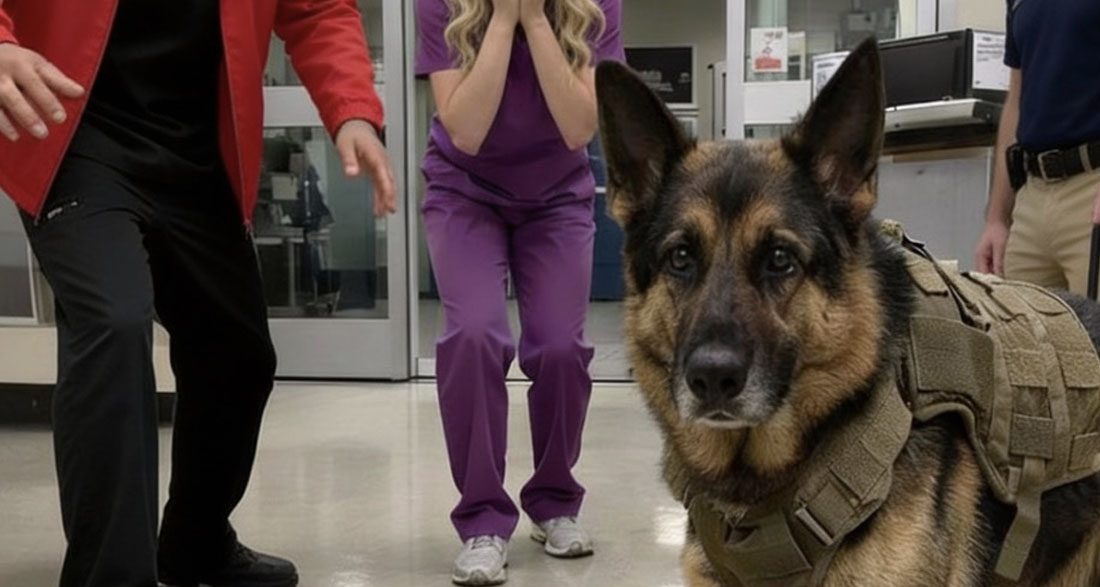
But it wasn’t an ambulance. No paramedics, no stretcher, no chaos—just a large, soaked German Shepherd sliding across the tile floor, claws scraping, body trembling from the cold. And he wasn’t alone.
He was dragging something behind him.
At first, my brain refused to process what I was seeing.
Then I saw it. A small, pale arm.
A child.
The dog clamped the sleeve of a little girl’s yellow jacket gently in his mouth, pulling her forward step by step. Her body flopped along like a ragdoll, limp and wrong, her head hanging to the side in a way that made my stomach twist.
“Sir, you can’t bring animals in here!” Frank, the night security guard, shouted, jumping up.
There was no sir. Just the dog.
He dragged her into the middle of the waiting area, gently letting her down on the floor, then stood over her like a guardian. Legs wide, chest heaving, eyes sharp and alert. He positioned himself between her and the rest of us like a living wall.
“Oh my God,” whispered Allison, one of the nurses. “She’s not breathing.”
Frank’s hand went to his taser. “Doc, that thing looks dangerous.”
“He’s protecting her,” I said without thinking. “Leave him alone.”
The dog growled softly—not loud, not wild, just enough to warn us to stay back.
I stepped forward slowly, raising my hands.
“It’s okay,” I said quietly. “You did good. Let us help her.”
The dog stared at me. Not like a normal animal stare, but with understanding, as if he was thinking. Then he made a low, broken sound, more fear than anger, and collapsed onto the floor, shaking.
“Code Blue, pediatric,” I shouted. “Now.”
Everything after that happened in a blur. We placed the girl on a gurney. Her skin was icy, lips blue, pulse barely there. The dog tried to rise again but limped along behind us, staying close.
“You’re bleeding,” Allison said, pointing.
Blood soaked his shoulder, dark and thick against his wet fur.
“He stays,” I said firmly when Frank tried to intervene. “He’s not going anywhere.”
In the trauma room, we worked frantically. Tubes, monitors, lines, numbers flashing, voices sharp and urgent. I cut away her jacket and froze.
Bruises. Old and new.
Across her arms, ribs, and back.
Around her wrist, the broken edge of a plastic restraint that had been chewed through.
“This wasn’t an accident,” Allison whispered.
“No,” I said, my stomach knotting.
The monitor flatlined.
I started compressions. Counted. Pushed. Felt the strange softness of a child’s chest under my hands. The room felt eerily quiet, filled only with the rhythm of machines and our tense breaths.
The dog dragged himself closer, resting his head on the bed, whining softly. Over and over.
Then the monitor beeped.
“She’s back,” someone whispered.
Relief washed over us, but it felt hollow. Something was still wrong.
As the girl was wheeled to CT, I turned to the dog. I cut away his muddy vest and stopped.
Kevlar.
A bullet wound.
“You’re not just a dog, are you?” I whispered.
A military tag gleamed in the dim light.
My phone buzzed. Sergeant Parker from local law enforcement. I ignored it, needing a moment.
“That’s Atlas,” Parker said quietly as he came in, rain dripping from his jacket. “He belongs to a retired Special Forces soldier, Grant Holloway. And he has a daughter.”
“Her name?” I asked.
“Maeve. She’s six.”
Allison returned, holding a small plastic evidence bag.
“We found this in her pocket,” she said softly. A wet piece of paper. A confession, a note, a tragedy all wrapped into one.
Then the lights flickered.
And went out.
Red emergency lights cast long shadows across the room. Atlas stiffened, ears forward, eyes scanning the dark hallway.
“He’s here,” I said, voice low.
A man’s voice echoed through the dark. “Doctor… I just want my daughter.”
Parker raised his weapon.
“I can’t come into the light,” the man said, voice breaking. “Not after what I’ve done.”
Atlas looked at me, then toward the CT area.
“Find her,” I whispered.
The dog ran.
Later, we found Grant Holloway sitting on the floor, shaking, weapon dropped. Atlas stood like a sentinel between him and the door.
“She’s alive,” I said gently. “Because of you.”
Grant crumpled, crying, body shaking in relief and guilt.
Maeve recovered. Slowly, with time and love. Atlas retired. Grant got help.
And I learned something that night. Heroes don’t always wear medals or uniforms. Sometimes, they come in muddy fur, tired eyes, and hearts that refuse to stop fighting.