

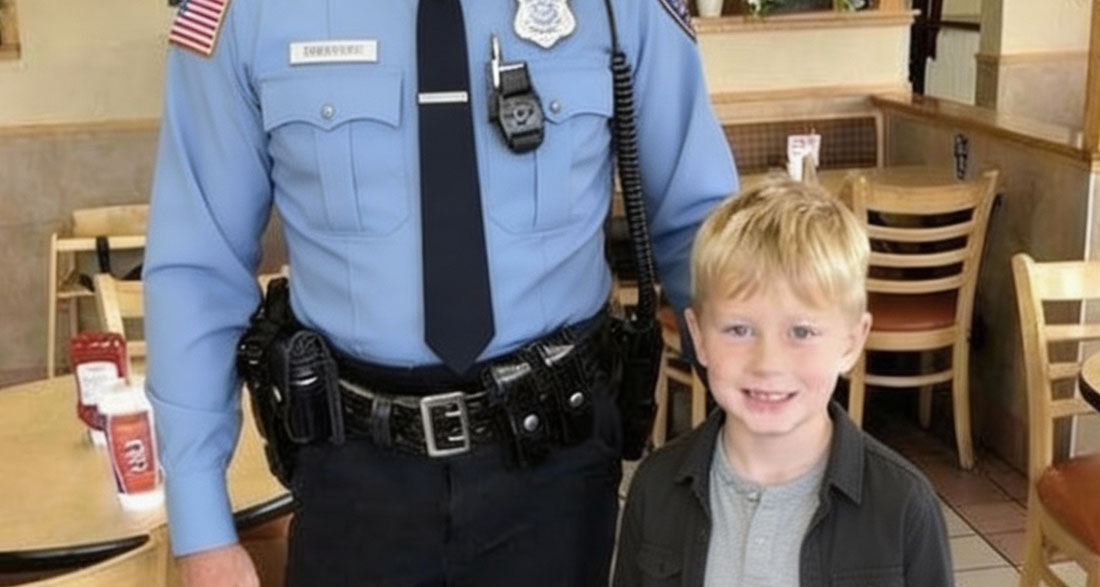
Barry turned eight on a gray afternoon that made it feel like the sky had forgotten how to rise. The air hung heavy, as if the day itself wanted to press down on us. I kept telling myself, It’s still his birthday. It’s still a day that should feel bright.
But when your pockets are empty and your mind is tired of pretending, hope feels fragile. I had pictured balloons tied to chairs, a cake big enough to make him gasp, maybe even a small pile of wrapped gifts that would make him feel like luck had finally turned our way.
But dreams are soft, and life… life presses hard.
I did what I could. We went to a small local diner, the kind with vinyl booths that groan when you sit down and flickering lights that seemed too tired to stay awake. We ordered burgers and fries. Nothing fancy.
Nothing that screamed, “It’s your birthday!” But Barry smiled anyway. That smile—steady, polite, grateful—didn’t belong to a child. It belonged to someone who had already learned too much about life’s costs.
When the waitress came back and asked if we wanted dessert, my stomach knotted. I wanted to say yes. I wanted him to have a slice of cake, something sweet to remind him birthdays aren’t meant to be swallowed by worry.
But the numbers in my head refused to bend. Before I could even open my mouth, Barry shook his head and told her he was full, patting his stomach like he meant it. I knew better. He was saving room—for me, for the moment, for something else.
That hit me harder than the truth of our situation ever had. Struggling is one thing. Seeing your child step into that struggle, understanding it in a way they shouldn’t have to—that’s another. Kids should want things without weighing the cost.
But Barry had learned to watch me, to soften his desires so they wouldn’t become another weight on my shoulders.
Across the aisle, a man in uniform shifted in his booth. The glint of a ranger badge caught a sliver of light. He was eating alone, a half-finished cup of coffee cooling beside him. He leaned over, voice warm and careful: “Mind if I buy your birthday boy a slice of cake?”
Pride flared in me, sharp and instinctive. I opened my mouth to refuse, but Barry spoke first.
“No,” he said.
Not afraid. Not embarrassed. Just a small, simple word, said with quiet seriousness. The ranger blinked, and I did too. Then Barry explained softly, the weight of his words strange for someone who hadn’t even lived a decade.
“I want to save my wish,” he said. “Last year I wished for a bike. It didn’t come. Wishes only work if they have a chance. I don’t want to waste another one.”
The diner seemed to hush around us. His words, quiet and honest, cracked the air in a way I wasn’t ready for. The ranger looked at him for a long moment, then stood without saying more.
He left some bills on his table—enough to cover more than his meal—and said gently, “The cake’s on me. Wish included.” And for once, I didn’t argue. I let the moment breathe.
The waitress returned with a slice of cake and a single candle, flickering like it wasn’t sure it belonged there. Barry stared at it, eyes softening, then closed them.
He held his breath, concentrated, and whispered a wish so quietly I couldn’t hear it. Then he blew out the candle. The smoke curled up and vanished like it had somewhere better to go.
The ranger asked us to wait outside after we finished. Not in a commanding way—more like a suggestion wrapped in certainty. I didn’t understand, but something steady in his tone made me trust him. We went.
The sky had darkened, and the air was colder. Barry kicked small rocks at the parking lot, hands in his too-thin jacket pockets, humming to himself. I kept glancing toward the diner, unsure why a stranger would care so much—but too afraid to question it.
Twenty minutes crawled by. I began doubting everything. Then a truck pulled in—not the ranger’s, but another marked with the same insignia. Another officer stepped out, and in the truck bed… a red bicycle.
Bright, shiny, with a huge ribbon tied around the handlebars, like something from a holiday commercial. The officer guided it down carefully, rolling it toward us.
Barry froze. His eyes widened slowly, disbelief blooming into wonder. The ranger stepped up beside him. “This bike was donated months ago,” he explained. “It’s been waiting for the right kid. Today, it found you.”
I expected tears. I felt them burn in my throat. But Barry didn’t cry. He laughed—big, loud, free. He climbed onto the bike immediately, wobbling, pedaling too fast, then too slow, then too fast again. Joy didn’t care about balance. It didn’t care about the gray, heavy day. It just existed.
Watching him, I realized something: I had been so close to letting shame steal this moment. If the ranger hadn’t insisted. If Barry hadn’t spoken honestly. If I had let pride wrap me like armor—the day would have ended gray and forgettable. But kindness had stepped in. Quiet. Gentle. No demands.
Later, at home, Barry buzzed with energy. He retold the story over and over, as if practicing so it wouldn’t vanish. When I tucked him in, he lay staring at the ceiling, a small smile tugging at his lips. “Maybe next year, I’ll wish for something for you,” he said.
I laughed. “You don’t have to.”
“I mean… hope,” he said. “I want to give back what I got today.”
That day wasn’t about cake or bikes or flickering diner lights. It was about quiet, deep things: strangers choosing goodness without hesitation, generosity that asks for nothing in return, a child learning the world can surprise you not with cruelty, but with compassion.
Watching him fall asleep, hands on the blanket, breathing steady, I realized something. The wish he made might stay with him longer than anything he could hold in his hands. Maybe not the bike—but the feeling of being truly seen by people who owed him nothing and gave anyway.
The world can be heavy. It can be cruel. But sometimes, when you least expect it, it opens just a little, letting light in. That gray afternoon, with nothing planned and nothing to offer, the world did exactly that.
Barry learned that wishes don’t always need to be whispered into darkness. Sometimes they take shape in strangers’ hands.
Sometimes they arrive in pickup trucks, roll across parking lots with ribbons tied to handlebars, and remind us that life—even when it feels small and limited—can grow a little bigger, a little brighter, a little more possible.
Maybe next year, his wish will be for me. Maybe not.
But that night, as the room darkened and the world quieted, I already had what I needed: proof that we weren’t alone, that good people still move through the world, and that sometimes, when the sky is gray and heavy, someone else steps in to carry the weight for a while.