

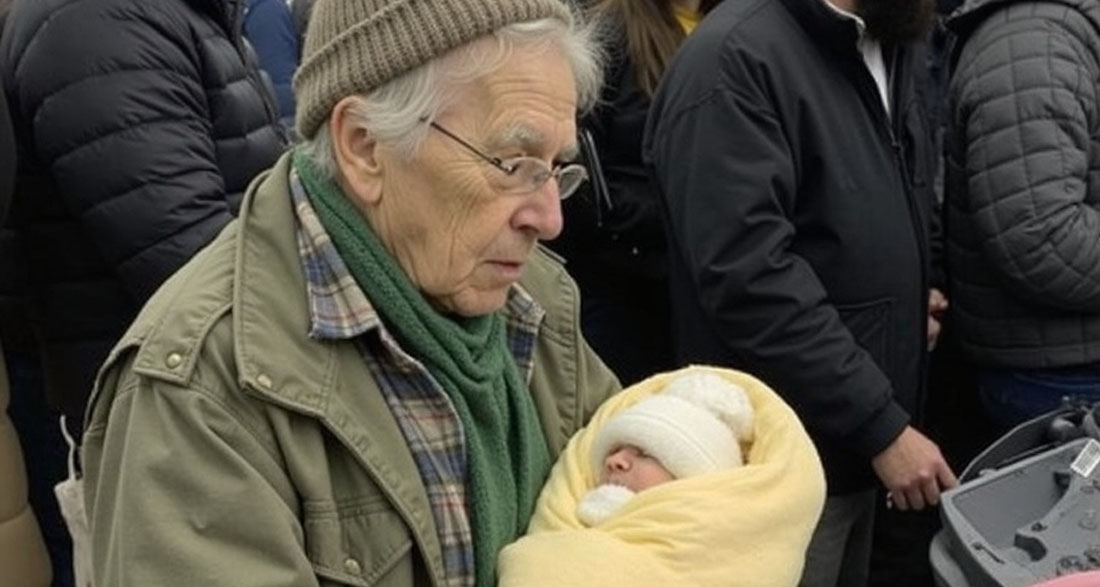
I was standing at the grocery store checkout, my six-month-old granddaughter, Lily, pressed tightly against my chest, when the machine beeped sharply, cutting through the air like a knife. Declined.
My heart sank immediately into my stomach. I held the edge of the counter, my hands trembling, feeling heat rise to my face. The cashier tried again. Another beep. Declined. My stomach twisted.
Behind me, impatience grew like wildfire. Someone laughed quietly but harshly. Another muttered, “People shouldn’t have kids if they can’t afford them.” A man let out a dramatic sigh, loud enough for everyone to hear, as if I was deliberately wasting his precious time.
I was seventy-two years old. My back ached, my arms were tired, and my heart was already heavy before I even stepped into that store. I survived on a tiny pension that barely covered rent and bills.
Every grocery trip was a careful battle. I counted my dollars, checked prices twice, made sure I didn’t buy anything unnecessary. That day, my cart was simple—diapers, formula, baby food, and a small package of turkey. Just enough to try and make something feel like Thanksgiving for the two of us at our little table.
Six months ago, my life had been completely different. I lived quietly, alone, in a small apartment. My days moved slowly, predictably. Tea in the morning, sunlight sliding across the walls, early to bed. I thought my hardest years were behind me.
I never imagined I would suddenly become a mother again—this time to my daughter’s child. I never imagined she would leave her tiny baby in my arms and vanish without a call, a message, or even a goodbye.
I never imagined I would spend sleepless nights filling out court forms, begging for help from cold-voiced offices, chasing endless waiting lists. Lily’s father was nowhere to be found. It was just the two of us. A fragile little life, completely dependent on me.
Back in the store, the cashier politely told me the total again. I had already done the math in my head. It should have worked. It always did. But something had gone wrong. A small, unexpected bill, a charge I hadn’t anticipated. One tiny mistake, and all my careful planning collapsed into public humiliation.
The whispers behind me became louder, sharper. Lily shifted in my arms, letting out a soft whimper. The noise, the bright lights, the eyes of strangers all made her uneasy.
The cashier began removing items, stacking them behind her on the counter. Diapers. Formula. Turkey. Each thud felt like a punch to my chest. My voice cracked as I leaned in, whispering, “Just the baby food, please… I’ll take only the baby food.”
I dug into my coat pocket for the crumpled bills I kept for emergencies. Eight dollars. Not enough, but it was all I had.
Lily began crying loudly, her tiny voice cutting through the store. A woman behind me groaned. Someone else snapped, “Babies shouldn’t be in stores like this!” My chest felt tight. I could barely breathe.
Then a calm voice cut through the chaos. “Ma’am. You with the baby.”
I turned slowly, bracing myself for another cruel remark. Instead, a man stepped forward. He wore a dark coat over a suit. His hair was neat, his face serious but gentle. His eyes didn’t judge—they simply saw me.
He held out his card to the cashier. “Please ring everything up again,” he said. “I’m paying.”
For a moment, time froze. Even the cashier looked uncertain, glancing at me for permission. I tried to protest. No words came out.
From behind, someone scoffed, “Planning to pay for everyone too?”
The man’s gaze shifted slightly toward the voice. His tone was calm, but firm. “If this were your mother struggling at the register,” he said, “how would you feel right now?”
The store fell silent. No one laughed. No one replied.
The cashier re-rang the items. The total came up. The man’s card went through immediately. The sound of approval felt unreal. My bags were handed to me. My hands shook as I held them.
“You don’t have to do this,” I finally managed to say, my voice breaking.
“It’s okay,” he said softly. “Please don’t worry.” He even helped lift a heavy bag into my cart. The people in line avoided my eyes now—the same ones who had laughed and whispered moments before.
Outside, the air was colder, sharper, like stepping into a different world. The man followed, pushing his cart. “Are you all right?” he asked.
I nodded, tears streaming down my cheeks. I told him I would repay him one day. He shook his head. “My mother passed away two months ago,” he said softly. “Helping you today helps me more than you know.”
I didn’t know what to say. Grief has its own language, and I recognized it in his voice. He noticed me adjusting Lily’s carrier and struggling with the bags. Without hesitation, he asked if I would let him drive us home. My instincts screamed caution, but something about him felt safe. I gave him my address.
In the car, Lily finally relaxed and fell asleep against my chest. Michael, he introduced himself, spoke quietly of his own two children, a boy and a girl. He told me about them with pride and a quiet sadness.
I found myself telling him my story—the sudden arrival of my daughter, her disappearance, the sleepless nights, the fear, the loneliness.
He listened without interruption. After a long pause, he said, “You’re very strong.”
I almost laughed. Strong? I felt tired, small, and afraid.
When we arrived at my building, he helped carry the bags upstairs. At my door, I thanked him again. He nodded. “I hope I see you again someday.”
The next afternoon, a knock at the door. I opened it carefully, Lily on my hip. Michael was there with a woman, Rachel, and their two children. They brought a grocery bag and a warm pie. “We wanted to make sure you’re all right,” Rachel said gently.
We sat in my small living room. The children played quietly with Lily’s toys. Rachel held my hand, firm and comforting. They stayed for over an hour. Before leaving, Michael handed me a folder.
Inside were pages of local childcare helpers, nannies, and support services. They offered to help cover the cost when I felt ready.
I didn’t accept immediately. Pride is stubborn. But exhaustion piled up. Nights blurred into days. I finally called the number Michael had given me. That’s how Patricia came into our lives—patient, gentle, and kind with Lily. She gave me real rest, something I hadn’t felt in months.
That Thanksgiving, instead of a quiet meal for two, we celebrated in warmth and noise. Michael, Rachel, their children, friends, and relatives filled the house. Lily laughed as she passed from arm to arm. For the first time in months, I felt my chest loosen.
Year after year, they invited us. Holidays became bright, loud, full of life. Michael checked in regularly. Rachel became someone I leaned on. Patricia stayed, becoming part of our little family. Lily grew fast. From crawling across my carpet to running in Michael’s backyard, her laughter filled the air.
I told Lily the grocery store story in pieces, not as a lesson but as part of how our lives became what they were. Michael once said, “People cross paths for reasons we don’t always understand at first.”
I think of that often. If my card had gone through that day, I would have left quietly, and we would have stayed alone. That brief failure became the doorway to a friendship—and a family—I never expected but will forever be grateful for.
I still live carefully, still count my money, still worry. But I am no longer alone. When Lily takes her first steps, Michael and Rachel are there. When she has her first day of school, their children stand beside her like siblings.
And when I look back at that store, the cruel murmurs, the register’s beep, I feel the hand that reached forward with kindness. I feel the moment the room fell silent. I feel the beginning of something I never imagined—but will always treasure.