

An hour before the wedding, I was hiding behind the kitchen door when I heard Caleb whisper to his mother, “I don’t love her. I’m marrying her for the house.”
For a moment, I couldn’t breathe. Those words hit me harder than anything I had ever felt in my life. The wedding was set in my mother’s estate—the home where I grew up, the place filled with memories of my father, laughter, tears, and love. And there he was, plotting to take it.
I froze, clutching my bouquet, my hands trembling. My heart felt like it was pounding so loud it might give me away.
Through the glass doors, the backyard looked perfect—rows of white chairs under the old oak trees, fairy lights twinkling between the branches, tables decked with roses and candles. Everything screamed romance. But behind that door, all I could feel was betrayal.
His mother, Deborah, chuckled softly. “Just get through the vows,” she said, voice smooth, like honey hiding poison. “After that… it’s ours.”
“Ours,” Caleb repeated, like it was the sweetest word in the world. “Ours.”
My stomach turned.
That house wasn’t a prize. It wasn’t something to be won. It was my mother’s pride, the home she had fought to keep after my father left.
I had spent years helping her restore it—painting walls, fixing the porch, repairing old photos that hung in the hallway. Every corner held memories of love, loss, and family. And Caleb wanted it like it was nothing but a trophy.
“She thinks it’s romantic,” he said casually, like he was talking about a game, not a person. “She doesn’t realize once we’re married, I can use it. Sell it. Leverage it.”
Deborah’s voice was calm, approving. “And if she resists?”
“She won’t,” Caleb said with a confidence that made my blood run cold. “She avoids conflict.”
Something inside me shattered—not because he was wrong about me being kind, but because he thought my kindness meant weakness.
I slipped away quietly, ghostlike, down the hall. My heart was hammering, but my hands were steady. I entered the bathroom, locked the door, and stared at my reflection.
A white dress. Pearls. Veil pinned perfectly. A picture-perfect bride.
But behind that image was a woman who just discovered her future was a lie.
I didn’t cry. I didn’t scream. I just let the silence settle around me.
He wasn’t marrying me for love. He was buying access.
I turned the faucet, splashed cold water on my face, and whispered to myself, “Okay.”
Then I tore off the dress.
The zipper jammed. The fabric clung stubbornly. I tugged, fought, pulled—lace ripped, beads scattered across the floor.
And I stood there, stripped of every illusion. I grabbed the navy-blue dress I had packed for the rehearsal dinner. Simple. Strong. Professional. Not a bride’s dress—but armor for a woman who finally understood.
I took one last look in the mirror. Makeup smudged. Hair slightly disheveled. But my eyes were sharp. I straightened my shoulders and walked out.
In my mother’s study, I locked the door and called my lawyer.
“Hi,” I said quietly, voice calm. Clear. “It’s happening. Cancel the ceremony, void the paperwork, and secure every property. Make sure nothing he owns reaches us.”
There was a pause. Then her crisp reply: “Understood. Ten minutes. Don’t sign anything. Don’t let him in.”
I hung up. For the first time, I felt lighter. My heart was still breaking, but it wasn’t collapsing—it was rebuilding.
Outside, I could hear guests arriving. Laughter. Soft music. Clinking glasses. Everything that should have felt joyful now sounded like background noise to a play I refused to star in.
I stepped outside.
The sun was warm. The roses smelled sweet. Caleb stood by the altar, perfectly dressed, smiling like he had already won. When his eyes found me, the smile faltered.
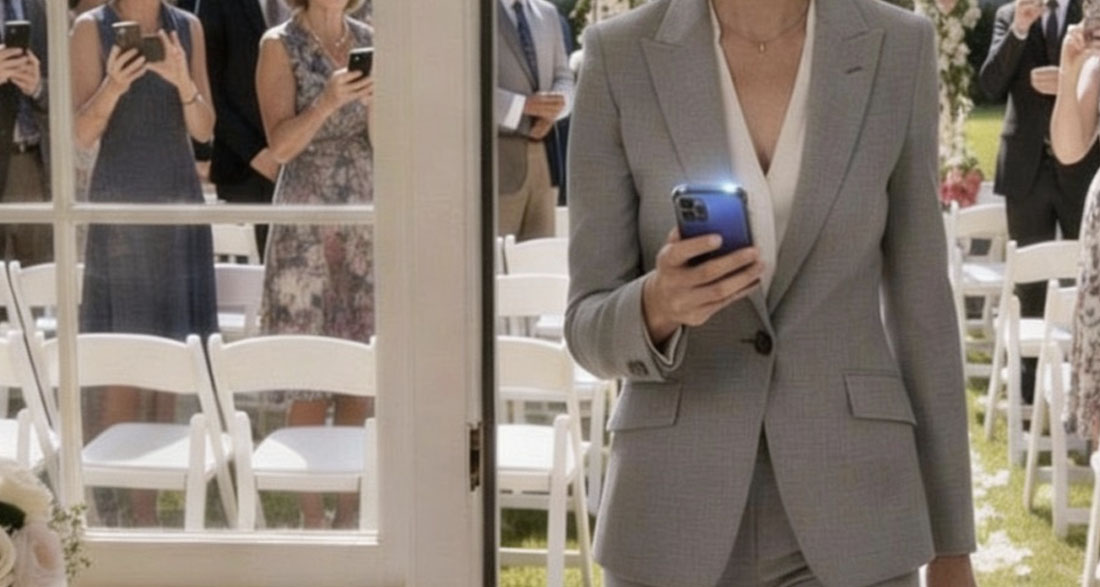
I wasn’t in white. I wasn’t walking toward him as a bride. I stood still. The navy dress swept across the grass. The crowd fell silent.
I met his gaze and said, “Time’s up.”
He blinked, confused. “What?”
“This wedding,” I said, lifting my phone, “is over. The paperwork is void.”
Whispers spread through the guests like fire. My mother gasped. Deborah’s face tightened. Caleb’s jaw clenched.
“You can’t just—” Deborah began.
“Oh,” I interrupted gently, “but I can.”
“This isn’t funny,” Caleb said, voice low.
“I know,” I said softly. “It’s tragic.”
He stepped closer. “We’ll talk later. You’re just nervous. Don’t embarrass me in front of everyone.”
Embarrass him. That was his concern—not my pain. Not the truth. Just his image.
“You embarrassed yourself,” I said quietly.
Deborah moved forward, her fake sweetness dripping. “Sweetheart,” she said, touching my arm, “you’re overwhelmed. Let’s go inside and—”
I pulled away. “Don’t touch me.”
Her mask slipped.
Caleb tried the charm that once worked. “Come on, baby. Don’t do this.”
I didn’t answer. I pressed play on my phone.
And his voice filled the air, clear as day:
“I don’t love her. I’m marrying her for the house.”
Gasps. Shock. My mother went pale. Guests whispered. Caleb lunged for the phone.
“Turn that off!”
“Don’t come closer,” I said firmly.
He froze. Half the guests were recording. Deborah’s voice wavered. “We can explain—”
“You can’t explain greed,” I said.
My phone buzzed: text from my lawyer. Contracts void. Property secured. Clerk notified.
I looked at Caleb. “You were saying?”
“You can’t cancel a marriage before it happens!” he shouted.
I tilted my head. “Exactly. That’s why I’m doing it now.”
He ran a hand through his hair, desperation creeping in. “You’ll regret this. You’ll be alone.”
I smiled faintly. “Being alone is better than being owned.”
My mother stepped beside me for the first time. Her voice trembled but was strong. “Is it true?”
“Yes,” I said quietly.
Her eyes blazed at Deborah. “You thought you could take my home?”
Deborah tried to speak, but nothing came out.
Caleb’s voice shook. “Let’s just go talk—”
“No,” I said firmly. “You’ve done enough talking.”
The guests didn’t move. Some shifted uncomfortably; others were glued to the scene.
“You’re making a scene. You’re throwing away a good man,” Deborah hissed.
I laughed softly. “A good man doesn’t scheme to take what isn’t his.”
Caleb snapped, “You’re painting me as the villain!”
“No,” I said calmly. “You did that yourself.”
He tried again. “You don’t understand—”
“I understand perfectly,” I said. “You wanted power. Property. Silence. But quiet doesn’t mean blind.”
For a second, his face crumpled—anger and fear battling. Deborah grabbed his arm, whispering frantically. He pulled away.
“This is insane,” he said. “No one will want you after this.”
“I don’t need anyone who thinks love is a transaction,” I replied. “I’d rather start over with nothing than stay chained to a lie.”
My phone rang on speaker. Lawyer. “All legal actions complete. Marriage license voided. Property protected. If they try interference, call police immediately.”
Caleb’s face went pale. “What?”
“It means,” I said, “you can’t touch my mother’s house—or me.”
Deborah’s voice cracked. “You can’t do this.”
I breathed slowly. “You did this to yourselves the moment you turned love into a business deal.”
The yard was silent except for the gentle wind through the trees. Fairy lights flickered over the flowers, mocking the ceremony that would never happen.
I looked at the guests. “I’m sorry for the confusion. But I’m not sorry for protecting myself.”
Then I turned to Caleb.
“You wanted a house,” I said quietly. “Here’s what you get instead.”
I pointed to the open gate.
“The door.”
My uncle stepped forward and widened it.
Caleb froze. Deborah tugged his sleeve, furious and humiliated. Together, they walked out—past the flowers, chairs, the altar—the entire illusion they had built to trap me.
And strangely, I didn’t feel triumphant. I felt free.
My mother pulled me into her arms. “You did the right thing,” she whispered.
For the first time that day, I breathed.
The guests remained quiet, unsure, until my mother cleared her throat. “There’s food. Please eat. It’s already paid for.”
Awkward laughter broke the tension. Music started low and soft.
I stood under the old oak tree, looking at the lights strung for a love story that never existed. The day hadn’t been ruined. It had just changed shape.
Truth, once spoken, doesn’t destroy—it frees.
Weddings don’t always need a groom. Sometimes they just need courage.
The navy dress clung like armor. The sun dipped low, golden light spilling across the garden. I hadn’t lost anything worth keeping.
I had gained the best thing: myself.