

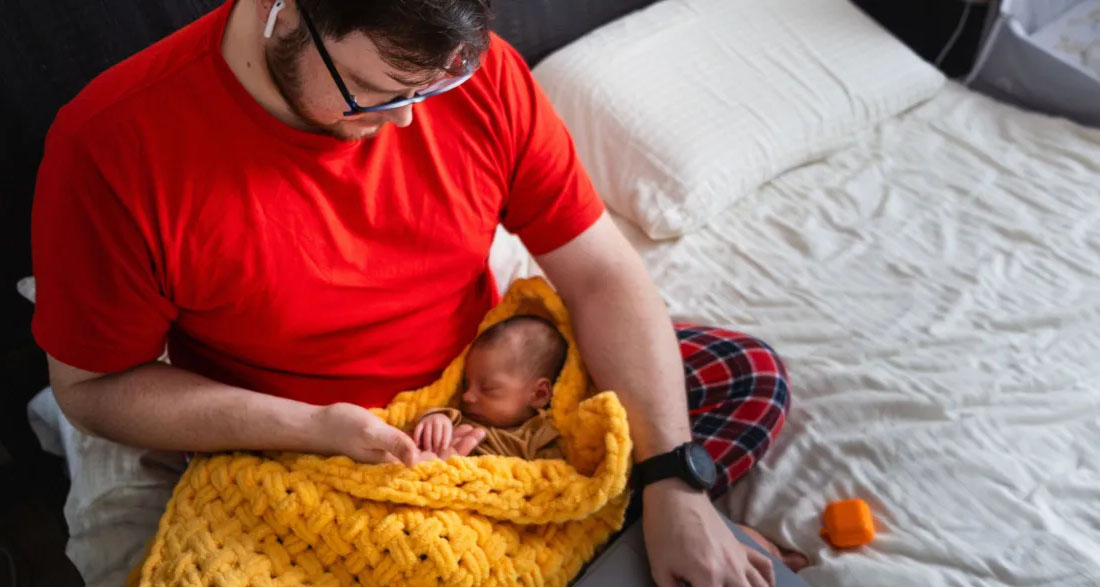
The first thing I noticed was the silence.
Real silence.
Not the soft quiet that came between feedings. Not the sleepy hush of a house at dawn. This was a strange, heavy silence that made my skin prickle.
My daughter Maisie was only three months old then. She usually woke every few hours, so silence wasn’t normal — it felt wrong.
I blinked at the baby monitor beside my bed. The screen was pure white noise, like it had frozen in the middle of something important.
I sat up fast.
Erin wasn’t in bed.
“Probably feeding Maisie,” I muttered to myself, pulling the blanket off and stepping into the hallway. The wooden floor was cold under my feet.
When I walked into the nursery, Maisie was asleep in her crib, tucked under her little fleece blanket, her tiny hands close to her chest. Her cheeks were warm and soft, glowing in the morning light. She looked completely untouched by worry.
But something else caught my eye.
She was curled around the sleeve of Erin’s favorite gray hoodie.
Erin had worn that hoodie through two winters. Through her whole pregnancy. Through nights full of cravings, swollen feet, and whispered “Do you think she’ll look like you?” in the dark.
Maisie was holding the sleeve tight, and the drawstring on the hood was missing — torn out on one side. A frayed thread dangled loose.
I stared for a second but brushed it off. Maybe it ripped in the wash.
I leaned down and kissed Maisie’s warm forehead. She stirred and squeezed the sleeve tighter.
I exhaled slowly, my relief mixing with confusion.
The clock on the wall read 6:14 a.m. Erin was always up early. She always made coffee first. She always hummed while she tidied the kitchen.
Today? Nothing.
No humming. No clinking cups. No running water.
I stepped into the hallway again, my heart starting to beat faster.
The kitchen was empty. Completely still.
The coffee pot was cold.
Erin’s phone was still plugged into the wall charger — screen lit, battery at 76%.
Her wedding ring was sitting inside the small ceramic dish near the sink. The same dish she always placed it in while washing dishes.
Except this time… she hadn’t put it back on.
No note.
No message.
No sound.
Nothing.
Just absence.
My wife had simply… vanished.
THE FIRST WEEK
That first week was a blur of panic.
I called every hospital in the state.
I texted her friends, her coworkers, random people she knew in high school.
I knocked on her mother’s door twice, even though Erin and her mom had barely spoken for months.
I left voicemails for Erin that became more desperate each day.
At night, I sat by the living room window, watching the driveway. In my mind, she would walk up the steps in her socks, tired and apologizing, holding some excuse that would make this all make sense.
But she never did.
People tried to comfort me with words that felt like sandpaper on open wounds.
“Maybe she has postpartum depression, Mark,” a neighbor said, handing me a basket of apples. “These things happen. And the mother always needs help.”
“Maybe she panicked. Maybe she just needed space to breathe.”
My own mother said, “Maybe you just missed the signs. That’s horrible on your part.”
I stopped inviting anyone over.
Some people looked at Maisie like she was something Erin had run away from. They didn’t say it, but I felt it in the long, awkward pauses after they asked, “Are you… coping?”
The house stayed exactly as Erin left it.
The gray sweater on the hook by the door.
Her mug with the letter E in the cupboard.
Her photos on the wall.
I didn’t erase her.
And I didn’t lie to my daughter.
THE TRUTH I GAVE MAISIE
When Maisie was four, she asked me one morning while I combed her hair:
“Did Mommy go to heaven?”
I swallowed the ache in my chest and lifted her onto my lap.
“No, baby. Mommy didn’t go to heaven. Mommy… left. I don’t know why. But it wasn’t because she didn’t love you.”
Maisie frowned.
“Did she not like me then?”
God, that question always stabbed me.
“She loved you, Maisie,” I said softly. “Something happened inside her. Something that made her leave. Maybe it was because of me, baby. But it was never your fault.”
Maisie nodded slowly, but I could tell the question stayed in her heart.
She turned five just a few weeks later.
THE NIGHT EVERYTHING CHANGED
It was a normal evening.
We were in the living room with a half-done pile of laundry between us. Maisie sat cross-legged on the rug, eating apple slices and playing with her dolls. The TV was on — one of those boring local programs I barely paid attention to.
Then Maisie froze mid-bite.
“Daddy,” she whispered. “Daddy, look.”
Her eyes were glued to the TV screen.
A woman stood under studio lights wearing a navy dress. Dark hair pulled back. A microphone clipped to her cheek.
The camera zoomed in…
She turned her head slightly…
And my entire world stopped.
Maisie’s voice trembled.
“That’s Mommy?”
It was Erin.
Older. Thinner. Eyes tired, like she hadn’t slept in years. But still her.
Still Erin.
I stood up slowly, my hands shaking around the shirt I was folding.
The TV host introduced her by a different name — a stage name. Apparently, Erin was an up-and-coming singer now. She had written a song about motherhood and starting again.
Then the camera zoomed close.
And Erin looked straight into the lens.
Straight into us.
“If Mark and Maisie are watching,” she said, her voice steady but sad, “I’m sorry. And I’m finally ready to tell you the truth.”
Maisie grabbed my hand.
“She said our names! She remembers us, Daddy!”
I couldn’t speak. My mouth was dry as sand.
On TV, Erin continued:
“I didn’t leave because I didn’t love you both. I left because I was drowning. I felt like I was disappearing inside myself. And I was scared that if I stayed, I’d become bitter… someone my daughter wouldn’t want.”
She paused, swallowing hard.
“I know I should have explained sooner. I know it wasn’t fair. But if you’re seeing this, I want you to know I’ve spent five years trying to find myself again. And now… I want to find my way back to you, too.”
She reached into her pocket and pulled out something tiny — the frayed gray drawstring from her hoodie.
“When Maisie was a baby, she’d fall asleep holding this. I kept it with me through every apartment, every city. It reminded me of what I almost gave up. Of what I hope I still have a chance to return to.”
The segment ended.
The room went silent again.
Thirty minutes later, my phone buzzed.
Unknown Number
A message popped up:
“I’m outside… Mark. Please don’t slam the door in my face.”
A car door shut in the driveway.
My heart jumped.
THE DOOR OPENS
I opened the door so fast the hinges groaned.
Erin stood there, coat zipped to her chin, arms folded tight like she was holding herself together. Her hair was pulled back. She looked exhausted, nervous, unsure.
A rental car idled behind her — engine running, like she wasn’t sure she’d be allowed to stay.
Maisie padded up beside me, barefoot, clutching her stuffed giraffe.
Erin’s eyes filled when she saw our daughter.
She crouched low, voice trembling.
“Hi,” she whispered. “Oh my goodness, you’re beautiful.”
Maisie stared, half-hidden behind me.
“You’re real,” she whispered.
“I am, sweetheart,” Erin said softly. “And I’ve missed you so much.”
I stepped slightly in front of Maisie without thinking — instinct, protection.
“Erin,” I said, “you disappeared. You vanished into thin air. You left your wedding ring in a dish. You left your baby in her crib. Why are you here?”
“I know, Mark,” she answered quickly. “I live with that every single day. I’m not here to make excuses. I’m here because I need to be honest.”
“Why now?” I demanded. “Why wait five years and show up on TV first?”
She breathed in shakily.
“Because I wasn’t ready until now. And I wanted Maisie to hear the truth from me… not from strangers.”
Maisie tilted her head.
“Did you love us?” she asked quietly.
Erin’s voice broke.
“I did. That’s part of why I left. I thought I was protecting you. When you’re drowning inside, love doesn’t always look right.”
I shook my head.
“That’s not protecting us, Erin. You abandoned us.”
She flinched, but she didn’t look away.
“I understand. I’m not asking for trust. I got help. Therapy. Meds. Support. I rebuilt myself. I’m finally whole. I can write songs. Perform. Live. I stayed away because I didn’t want to come back broken.”
“You could have reached out,” I said bitterly. “You could have checked on us.”
“I did,” she said quietly. “Through your mother.”
I froze.
“What?”
“I sent money through anonymous checks. For Maisie. I didn’t want you to feel… anything about it. So I never told you.”
My mother had never mentioned this.
Ballet shoes.
Groceries “on sale.”
Extra supplies for Maisie.
All the times she said, “Don’t worry about it, honey.”
Now it made sense.
Maisie whispered:
“Were you the lady in the back… at my recital? I think I saw you.”
Erin’s face crumpled.
“Yes, sweetheart. I was too scared to come closer. But I was there.”
Maisie looked up at me.
“Can she come in now, Daddy?”
My whole body said no.
But her small, hopeful eyes said yes.
“Go turn off your car before you kill the battery,” I told Erin.
She nodded and walked off quickly, like afraid I’d change my mind.
I turned to Maisie.
“Go get socks. Your feet are freezing.”
She ran down the hallway.
TALKING IN THE DARK
Later, after Maisie fell asleep, Erin and I sat in the kitchen.
She held a mug of tea she never drank. Steam curled into the air between us like something trying to escape.
“I didn’t come back for attention,” she said. “Or because the tour ended. Therapy helped. They diagnosed me with postpartum depression. I didn’t even know I wanted to sing until I started writing.”
I stared at her, tired.
“And now you want Maisie to sing in a studio? With you?”
“It’s just one chorus,” she said softly. “I thought maybe… we could do it together.”
“You thought wrong,” I replied.
She didn’t argue. She lowered her eyes.
“I get it. I do. I just wanted to share something I built. Not take her. Not replace you. Just… show her.”
“You don’t get to call it building a family when you ran from one.”
“I’m not pretending I didn’t,” she whispered. “But I’m here now. And I’ll earn whatever I’m given.”
She looked smaller under the kitchen light. Not like the singer on TV. Just Erin — the woman I once trusted with everything.
“You’ll see Maisie,” I said. “But on my terms. Supervised. I’m the one who stayed. I decide what happens next.”
Erin nodded.
“I understand.”
She stood, setting her mug down gently.
“I’ll head out. You can tell me when… or if I can see her again. I won’t push.”
She paused at the doorway.
“Thank you, for not shutting the door completely, Mark.”
She slipped outside.
The door clicked softly behind her.
And down the hallway, Maisie stirred in her sleep — the house shifting, healing, changing.
For the first time in years… the silence wasn’t empty anymore.