

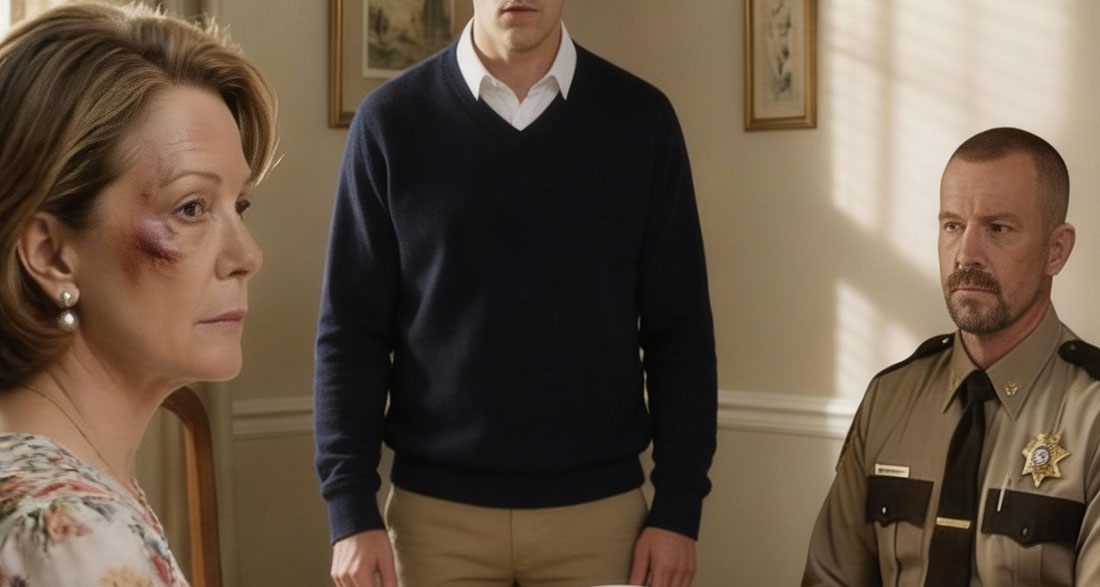
My son hit me last night. And I said nothing.
This morning, I woke early, before the sun even touched the horizon. I laid out my lace tablecloth—the one my mother gave me when I married. I brought out the fine china, the plates with little blue flowers, the ones that only came out for holidays.
I cooked a full Southern breakfast: biscuits golden and flaky, scrambled eggs fluffy and bright, crisp bacon, and grits buttered just the way Daniel liked them when he was a boy.
Sausage gravy was whipped smooth, filling the kitchen with a rich, comforting smell that almost made me forget the anger and fear still lingering in the air. Almost.
When Daniel came downstairs, hoodie up, phone in hand, eyes half-closed, he sniffed the air, smirked, and said, “Looks like you finally learned.”
But his smile died the moment he saw who was sitting at the table.
I’m Margaret Collins. I’m sixty-two years old. My son, Daniel, is thirty-four. He’s far too old to act like a boy—but last night, in that moment, he was exactly the angry teenager I once grounded for talking back.
He had shouted at me many times before, but this was the first time his hand had struck me hard enough to leave a metallic taste in my mouth.
I didn’t scream. I didn’t cry. I just stood, gripping the kitchen counter, waiting for him to stop yelling. He stormed out, slamming the door so hard the glass panes rattled. I could hear the rumble of his truck fading down the road, leaving the house in a deafening silence.
The quiet afterward was heavy. The refrigerator hummed.
The wall clock ticked. My own breathing felt shallow, unsteady. I went to the bathroom, looked in the mirror, and saw the faint red mark spreading across my cheek. I pressed a cool washcloth to it until the sting eased, but the memory of his hand remained, etched into my mind.
I didn’t call anyone. What could I say? That my grown son, the boy everyone said was “so responsible,” had hit his own mother? That the same hands I once held when he learned to walk had now struck me? I didn’t want pity. I didn’t want anyone’s judgment.
I sat at the kitchen table almost until midnight, lights dim, the faint smell of fried chicken from dinner lingering.
I thought of my late husband, Paul, who had always sat here with his evening paper, talking about the weather, the crops, or the sermon from Sunday. Twelve years gone, but still vivid in my memory. He never raised a hand to me. Not once.
And I remembered Daniel as a little boy—gentle, curious, sweet. Crawling into bed during thunderstorms. Bringing home school drawings to tape on the fridge. But after Paul died, something in Daniel hardened. At twenty-five, he lost his job, fell into a rough crowd, drank too much, and somehow ended up back in my house “just for a few months.” Those months stretched into three years.
He promised he was getting back on his feet. I wanted to believe him. I wanted to believe the boy I raised was still there. But the longer he stayed, the smaller I became. Friends stopped coming over.
I tiptoed around my own home, careful not to say the wrong thing. Bills, noise, food, the temperature—he snapped at it all. And I told myself, He’s stressed. He’ll calm down.
Last night proved he wouldn’t.
That morning, I made breakfast with purpose. Not just to feed him, but to set the stage. The lace tablecloth. The china. The food. Everything perfect. When Daniel appeared at the bottom of the stairs, the smell of biscuits and gravy filled his nostrils. He smirked.
“So you finally learned, huh?” he said, voice teasing. “Guess that slap knocked some sense into you.”
I didn’t answer. I poured coffee, my hand steady, eyes calm.
He laughed, grabbed a chair, reached for a biscuit—and froze.
His eyes moved from the food to the people seated at the table. His face went pale.
At the head of the table sat Sheriff Thomas Reed, his hat neatly beside his plate. To his right was Pastor William Harris from First Baptist, calm and composed. Next to them sat my sister Elaine, who had flown in from Ohio the night before after a single quiet phone call.
“What… what is this?” Daniel’s voice cracked.
“Sit down, Daniel,” Sheriff Reed said, calm but firm. “We need to talk about last night.”
The clock ticked loudly, almost as if marking the weight of the moment. Daniel hesitated, his body tense. Slowly, finally, he sat.
“You called the police on me? After everything I’ve done for you?” he spat, trying to sound angry.
“Everything?” I asked quietly. “Living here rent-free for three years? Yelling at me every time dinner wasn’t ready when you wanted it?”
He flinched.
Pastor Harris cleared his throat softly. “Daniel, your mother showed me the bruise. She told me everything.”
Sheriff Reed slid a folded document across the table. “This is her statement,” he said. “Assault of a family member is taken seriously in this county.”
Daniel’s eyes darted from face to face. Disbelief shifted to fear. “Mom, I didn’t mean it,” he said, voice softer now. “I was stressed. You know how things have been lately.”
Elaine’s voice was sharp, cutting through the air. “So was your father. And he never laid a hand on anyone.”
“You’re overreacting. This is crazy,” Daniel said, jaw tight.
“No,” I said, voice steady. “This is accountability.”
The sheriff explained the process, the options, the consequences. Daniel’s hands trembled over the napkin. For the first time in years, he didn’t look angry. He looked lost.
“I’ll leave,” he said finally, voice cracking. “I’ll pack my things.”
“That’s already arranged,” Elaine said. “Mark’s coming with his truck in an hour.”
Daniel’s mouth twisted. “So that’s it? Breakfast and betrayal?”
“This,” I said quietly, “is breakfast and boundaries.”
He jumped up, chair scraping the floor, and stormed upstairs. Drawers slammed. Silence settled again, except for the lingering smell of bacon.
When he returned with his bags, he didn’t look at me. He walked past us and out into the morning light, stiff and angry. I watched as he loaded boxes into the truck. No goodbye.
After the sheriff and pastor left, they each stopped to squeeze my shoulder. “You did the right thing,” Sheriff Reed said softly.
I nodded, throat tight. Loving a child doesn’t mean letting them hurt you. I wished I’d learned that sooner.
The house felt heavier and lighter at the same time. Peace had returned. That night, I slept through, no footsteps pacing the hallway, no angry voices, just quiet.
The next days were a blur. I washed the lace tablecloth, folded it neatly. I cleaned Daniel’s room—not in anger, but in closure. Empty beer cans, broken chargers, piles of clothes—gone. Old photographs of him smiling, arm around me at the county fair—I tucked them into a box, protecting the memories, not forgetting them.
Sheriff Reed checked in once, just to make sure I was safe. Pastor Harris stopped by with a pie and a prayer. Elaine stayed a week, hugging me tightly before flying home. “You’re stronger than you think, Maggie,” she said.
I joined a support group at the community center. At first, I barely spoke, just listened. Guilt, shame, exhaustion, hope—every story echoed mine. One woman said, “We keep trying to fix them until we break ourselves.” That line stayed with me.
I began seeing a counselor. She helped me untangle years of fear, anger, and grief. She reminded me it’s okay to mourn the relationship I wanted with my son, even while protecting myself from the one that existed.
Daniel was ordered to attend anger management. I heard he moved in with a friend across town. We haven’t spoken since. Maybe one day we will. Maybe not. For now, the silence is mine, and it’s peaceful.
I still cook nice breakfasts. I still lay out that lace tablecloth, bring out the china. But now, it’s for me. It’s a reminder that I’m worthy of care and dignity, even when no one’s watching.
Some mornings, when the sunlight hits just right through the kitchen window, I can almost see the younger version of myself sitting across from me, quiet, afraid, hoping things would change. I smile and think, You did it. You finally stood up.
This isn’t revenge. It’s reclaiming space that was always mine. Love without respect isn’t love. Survival matters.
I remember the slap, yes, but I also remember all the small cuts, the raised voices, the fear I brushed off because he was my son. I used to think love meant endless forgiveness. Now I know it also means boundaries.
If someone told me I’d one day call the sheriff on my own child, I’d have said they were crazy. But life teaches that strength can be silence—and sometimes, it’s speaking up.
I’m not angry anymore. I walk freely, play soft music, leave the doors open for the breeze. Peace. Simple, quiet peace.
Sometimes, when I pause at Daniel’s empty room, I whisper a prayer—not for him to return, but for him to heal. Forgiveness isn’t forgetting. It’s freeing yourself.
You’re not alone. Staying doesn’t make you weak. Leaving doesn’t make you cruel. Boundaries don’t mean you’ve stopped loving. They mean you’ve started loving yourself. And sometimes, that’s the bravest thing of all.