

Every Sunday, my son Mark and I went for a walk.
We had been doing it for two years straight, ever since my wife died. No excuses. No skipping. No matter how tired I was, no matter how many emails piled up at work or how many forms waited on my desk, Sunday walks were sacred.
Just the two of us.
Mark needed them. And if I was honest with myself, I needed them just as much.
Mark is a bright kid. Kind in a way that makes my chest tighten sometimes, because the world doesn’t return that kindness very gently. Since his mom passed away, everything feels sharper for him. Sudden noises make him flinch. He asks questions I don’t know how to answer.
Sometimes, he watches me like he’s waiting for me to vanish too.
Some days, I still forget she’s gone. I’ll turn, ready to tell her something silly or frustrating, and I’ll be met with empty air. Those moments hit like a punch to the ribs.
They gut me every time.
But I never let Mark see it. I can’t. I won’t.
I’m 36 years old, and I have no idea how to do this alone—but my son doesn’t need to know that.
So we walk.
That Sunday, the sky was pale blue, washed out like old denim. Families were scattered along the path. Couples walked their dogs. Joggers passed us with earbuds in, lost in their own worlds.
It was a completely normal day.
Until it wasn’t.
We were halfway around the lake when Mark stopped so suddenly that I almost walked straight into him.
“Mark?”
He didn’t answer.
He was staring down at the grass like he’d found something precious. Then he crouched and reached into the weeds, pulling something free.
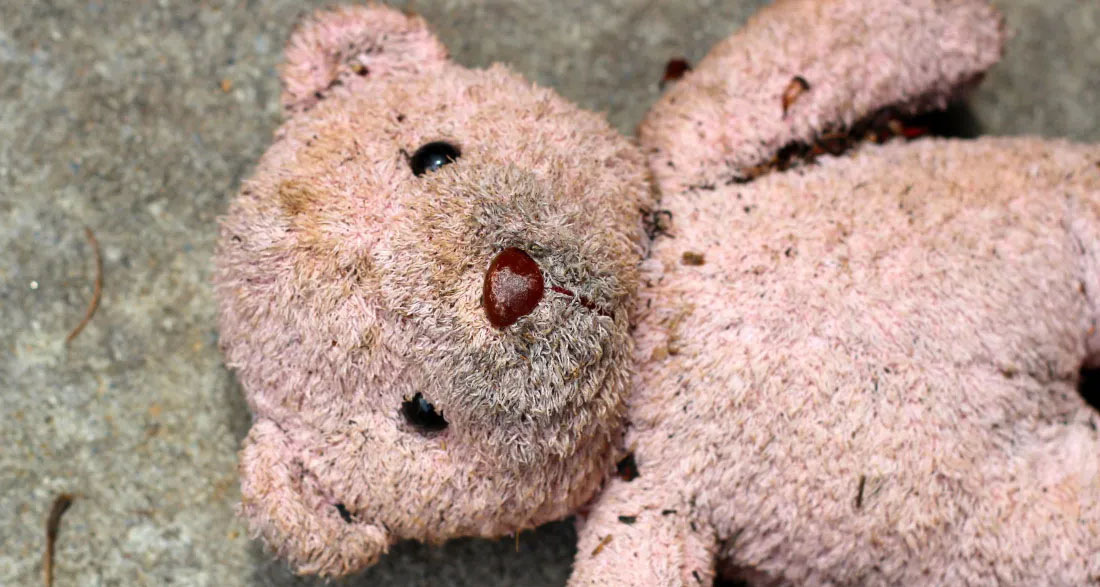
A teddy bear.
And not just any teddy bear.
It was filthy.
The fur was matted with mud. One eye was completely gone, leaving behind a dark, empty socket. There was a rip along its back, and the stuffing inside looked dry and lumpy, like it had been there for a long time.
Anyone else would have left it where it was.
But Mark wrapped his arms around it and held it tight to his chest.
“Buddy,” I said gently, crouching beside him. “It’s really dirty. Let’s leave it here, okay?”
His fingers tightened.
“We can’t,” he said quietly. “He’s special.”
I saw it then—that look in his eyes. The one where he’s about to cry but refuses to let the tears fall. The look that breaks me every single time.
“We can’t leave him,” he repeated.
I sighed, defeated. “Alright. We’ll take him home.”
At home, I spent over an hour cleaning that bear.
It would’ve been faster to soak it completely, but Mark asked, “Will he be dry enough to sleep with tonight?” So I was careful. I used soap and scrubbed gently, then ran the wet-and-dry vacuum over it again and again until the dirt finally came out.
It took several passes before it looked clean.
I disinfected it with rubbing alcohol and stitched the torn seam in its back with careful, steady hands.
Mark watched every step, hovering close, touching the bear every few minutes like he needed to make sure it was still real.
“When will Bear be ready?” he kept asking.
That night, when I tucked Mark into bed, he hugged Bear close. I stood there for a moment, watching his breathing slow as sleep finally took him.
I reached down to adjust his blanket.
My hand brushed Bear’s belly.
Something clicked inside.
Static exploded from the toy—sharp and loud.
Then a voice came through the fabric. Small. Shaking.
“Mark… I know it’s you. Help me.”
My blood turned to ice.
That wasn’t a song. It wasn’t a broken toy or a recorded message.
That was a real voice.
A child’s voice.
And they had said my son’s name.
I looked at Mark. He was still asleep, somehow undisturbed.
Carefully, I slid the bear from his arms and backed out of the room, closing the door almost all the way.
My mind raced.
Was this a prank? Some kind of recording device? Was someone watching us?
I carried the bear down the hallway like it might explode.
Under the bright kitchen light, I ripped open the seam I had stitched only hours earlier. Stuffing spilled onto the table. Inside, my fingers hit something hard.
I pulled it out.
A small plastic box. A speaker. A button. All held together with duct tape.
Then the voice spoke again.
“Mark? Mark, can you hear me?”
If that had been an adult’s voice, I would’ve called the police immediately. But this was a child.
And they were asking for help.
I pressed the button. “This is Mark’s dad. Who is this?”
Silence.
“No, wait,” I said quickly. “You’re not in trouble. I just need to understand what’s going on.”
Static hissed.
Then the voice came back, shaky and scared.
“It’s Leo. Please help me.”
Leo.
The boy Mark used to play with at the park every weekend. Always laughing. Always falling and scraping his knees.
He’d stopped coming months ago.
“Leo, are you safe right now?” I asked.
No answer.
By morning, I had barely slept.
When Mark came into the kitchen, he asked right away, “Where’s Bear?”
“He’s okay,” I said. “But we need to talk.”
“Do you remember Leo?” I asked.
His face lit up. “From the park?”
“Did he seem different the last time you saw him?”
Mark frowned. “He didn’t want to play tag. He said his house was loud now. And that grown-ups don’t listen.”
“Did he tell you where he lived?”
“The blue house near the park,” Mark said. “With the white flowers.”
After dropping Mark at school, I drove straight there.
Leo’s mom answered the door, surprised.
When I explained everything, her face crumpled.
“Oh my God,” she whispered. “Leo…”
She admitted she’d been working too much. Missing things. Not listening enough.
That Saturday, we met at the park again.
The boys ran toward each other and collided in a clumsy, perfect hug.
“Don’t disappear again,” Mark said.
“I won’t,” Leo promised.
Now they meet every other weekend.
And Bear sits on a shelf above Mark’s bed.
It never speaks anymore.
And that’s exactly how it should be.
But I listen more closely now—to the quiet things. The unspoken cries for help.
Because sometimes, the loudest pleas are the ones barely whispered at all.