

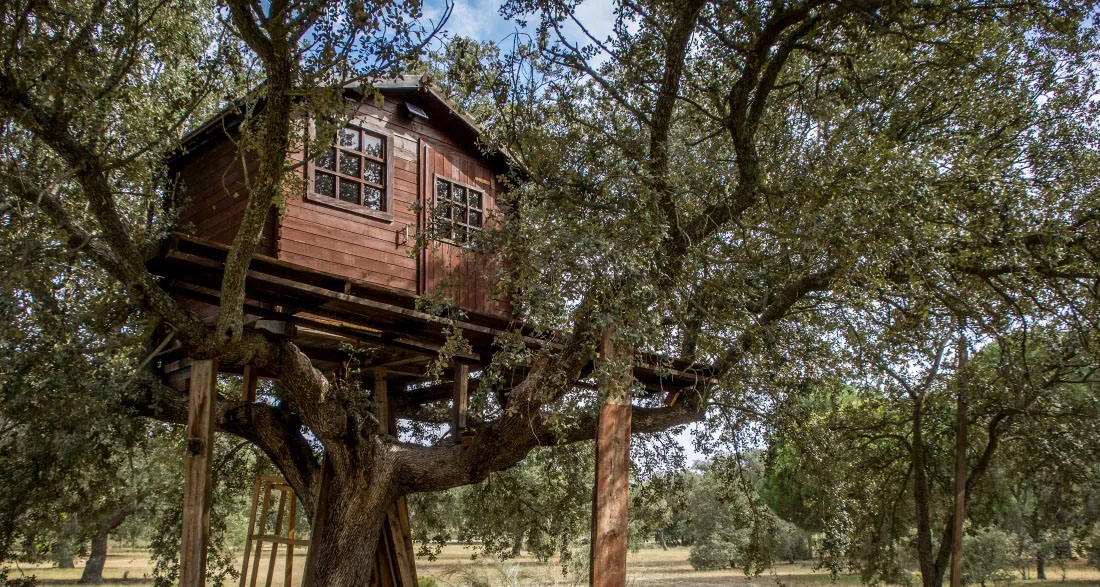
My eight-year-old stopped talking completely. He vanished into the treehouse my late husband, Josh, had built, and came back with strict new rules: boys-only, no questions. Then, one night, I heard him whisper into the darkness like someone was answering.
A month after Josh died, our house still sounded full of him. The hallway floorboard near the linen closet creaked under imagined boots, and the bathroom fan rattled as if it were clearing its throat. I kept listening for his keys, as if grief could be tricked by habit.
Josh had built Sean a treehouse.
Sean took his father’s death the hardest. He was eight, and Josh had been his entire world.
He stopped talking at breakfast, poking at the skin around his nails until they bled. When I asked gently, “Do you want to talk about Dad?” he shrugged and stared at his cereal like it had personally offended him.
Josh had built the treehouse in the backyard just before he got sick. It wasn’t fancy—just real wood, real nails, a little crooked window because Josh said, “Character matters.”
After the funeral, Sean started disappearing up there every day. At first, I let it happen.
If the treehouse helped him feel close to his dad, fine. I could live with splinters and dirt tracked into the kitchen. But Sean didn’t just sit there. He stayed. Hours passed. Sometimes it was an hour, sometimes three. Once, he carried a blanket and a pillow like he’d moved out.
“Sean,” I’d call from the yard. “Come down for dinner.”
His serious face appeared in the window. “Not yet,” he said. “I’m busy.”
“Busy doing what?”
“It’s boys-only territory,” he replied. “You’re not allowed, Mom.”
A few days later, his teacher called.
At first, it almost sounded like a joke, like Josh was still guiding him. Then Sean started bringing messages inside.
One morning, he slid into his seat and said, “Dad says you shouldn’t be sad.”
My spoon froze in mid-air. “Sweetie… Dad can’t say things anymore.”
Sean’s eyes narrowed. “Yes, he can. He talks to me.”
A few days later, his teacher called again. “Sean’s grades have dropped,” she said softly. “He keeps telling other kids his dad is still around.”
“Dad told me today that he loves us so much,” Sean said later, voice tight.
I thanked the teacher, sat on the couch, and stared at nothing—the kind of numb that empties your bones.
That afternoon, Sean tossed his backpack onto the floor. “Dad says don’t be mad about my grades,” he said. “He says I’m trying.”
I forced myself to breathe. “Who told you that?”
Sean looked at me like it was obvious. “Dad. In the treehouse.”
That night, after I tucked him in, he sat up suddenly. “Mom, Dad told me today that he loves us so much.”
I stayed silent. My throat tightened. I smoothed his hair with shaking fingers. “I know he loved you.”
“No,” Sean insisted. “He told me today. How can he be dead if I talk to him every day?”
I didn’t have an answer that didn’t sound like another loss. I kissed his forehead, turned off the light, and stood in the hallway until my hand went numb on the doorknob. From his room, I heard him whisper, “Night, Dad,” as if it were normal.
The next evening, Sean refused to come in. I called him, louder and louder, panic sharpening my voice.
“Sean! Bedtime. Now!”
No answer.
Then I heard Josh.
I grabbed my shoes and ran outside. The grass was damp. Lantern light flickered through the treehouse window like a heartbeat. I was halfway to the ladder when I heard Sean’s soft, cracked voice.
“Dad, I miss you so much. I really, really need you.”
I froze, hand on the ladder rail.
Then Josh’s voice came—clear, steady, close.
“I miss you too, buddy. I’m right here.”
My stomach flipped. I climbed, hands moving like they belonged to someone else.
“Mom!” Sean barked when my head rose above the floor. His cheeks were wet. “Stop! You’re not allowed!”
“I’m your mother,” I said. “Move.”
He spread his arms. “It’s boys-only. Dad said—”
“Sean.” My voice snapped. “I heard that. I heard him.”
The treehouse was warmer than it should’ve been, smelling of pine and sweat. A camping lantern threw deep shadows into the corners. I turned, searching for… something. Anything.
Josh’s voice came again, calm. “Em,” he said, the nickname only Josh used, “please don’t scare him. Just listen.”
My heart slammed. “Who is this?”
Sean dissolved into sobs. “See?” he cried. “Dad’s here! Stop being mean!”
“Whoever you are, stop talking to my son.”
The sound wasn’t coming from thin air. It came from the treehouse walls.
I crouched, pressed my ear to a plywood panel, following vibrations until I found a loose plank. Behind it, taped to a beam, was a small black speaker with a wire running through the floor.
My hands shook. “Sean, what is this?”
He wiped his nose on his sleeve. “It’s… it’s Dad,” he whispered, doubtful now.
Josh’s voice crackled again. “Sean, it’s okay. Do what your mom says.”
I stared at the speaker. “That’s not him,” I said. “Whoever you are, stop.”
“He said you’d ruin it if you came up.”
Static.
Then Josh’s voice again: “Em, please. I’m trying to help.”
Rage flared. “Help? You’re wearing my husband’s voice like a costume.”
Sean grabbed my arm. “Mom, don’t make him mad,” he pleaded. “He said you’d ruin it if you came up.”
“Who told you that?” I asked, softening.
Sean’s lips trembled. “Uncle Mike,” he whispered.
My stomach dropped.
Mike was Josh’s friend from work—the one who’d brought casseroles after the funeral, hugged Sean too long at the graveside, and said, “If you need anything, I’m here.”
“When did Mike come here?” I asked.
“When you’re at work,” Sean said. “He brings snacks. He fixes stuff. He says it’s a secret mission.”
The wire ran to a cheap device under the floorboard. This wasn’t a recording.
A phone rang near the side gate. Someone was listening.
“Mike,” I said into the speaker, voice shaking, “I know it’s you.”
Silence. Then a careful exhale. “I didn’t want it to be like this,” said Josh’s voice.
I climbed down with Sean clinging to me. The backyard felt too open, too exposed.
“Mike!” I called. “Get out of here!”
Mike stepped into view, pale, hands raised.
“I was trying to help,” he said.
“Explain,” I demanded. “You used my dead husband to talk to my child.”
“Sean was falling apart,” he blurted. “You were falling apart. I thought if he heard Josh, he’d feel safe.”
Sean’s head snapped up. “Uncle Mike?” he whispered.
Mike looked at him pleadingly. “Buddy, I was trying to help. It’s Dad’s voice. It’s still Dad, in a way.”
“No,” I said.
Mike flinched. “It’s an AI model,” he admitted. “Josh left voicemails, videos… I trained it. I just needed Sean to calm down.”
“And the ‘boys-only’ rule?” I asked.
“You would’ve shut it down,” he said, avoiding my eyes.
I noticed a manila envelope tucked under his arm.
“What’s that?” I asked.
“Just paperwork,” he said too fast.
Josh and Mike had owned a small contracting business. Josh’s death had left a messy pile of accounts, equipment, and insurance. Mike had said he’d “handle it quietly.”
“Give it to me,” I said.
Sean whimpered, “So Dad wasn’t talking to me. He’s really gone.”
I pulled him close. “He’s gone,” I whispered. “I’m sorry.”
Mike stepped closer. “You don’t have to do this the hard way. Sign it, I’ll stop. I’ll take it down.”
My vision tunneled. “You weren’t comforting my kid. You were controlling him.”
Sean wailed into my shirt. “I just wanted Dad!”
“I know,” I said. “I know.”
Up in the treehouse, a piece of paper caught my eye. I climbed and tugged it free.
Josh’s handwriting: “Laura—if something feels wrong… Protect Sean. Don’t let anyone use me against you.”
I shoved the note at Mike. “He knew,” I said.
I dialed 911.
Mike lunged for the note and speaker. The ladder shook. Sean screamed. I yanked him behind me. “Go inside! Now!”
The police arrived quickly. I handed over the devices and the note.
“Do you want to press charges?” the officer asked.
I nodded.
After Mike was led away, Sean stared out the window. “Is he going to jail?”
“I don’t know,” I admitted. “But he’s not coming near you again.”
That night, Sean refused his room. He curled on the couch, knees to chest, eyes hollow.
“You can be mad. You can be sad. You can be both,” I said.
He swallowed. “What if I forget Dad’s voice?”
I pulled up a video of Josh dancing in the kitchen while Sean laughed and snorted. Josh looked at the camera and said warmly, “I love you, kiddo.”
Sean’s chin wobbled.
“Can we go up there?” he asked.
“That’s him,” I said softly. “We don’t have to pretend.”
The next day, I locked the treehouse ladder with a padlock. Lies were the enemy. The treehouse wasn’t.
A week later, Sean asked cautiously, “Can we go up there? Together. No secrets.”
I hesitated, then nodded. “Okay. But we do it our way.”
“I miss him,” he whispered.
We climbed with a blanket and flashlight. Sean placed one of Josh’s old work gloves on the shelf. We sat close, knees bumping. The treehouse creaked, but for once it sounded like wood—not ghosts.
Sean stared out the crooked window. “I miss him.”
I leaned my head against his and let tears fall quietly. “Me too,” I said. “Every day.”