
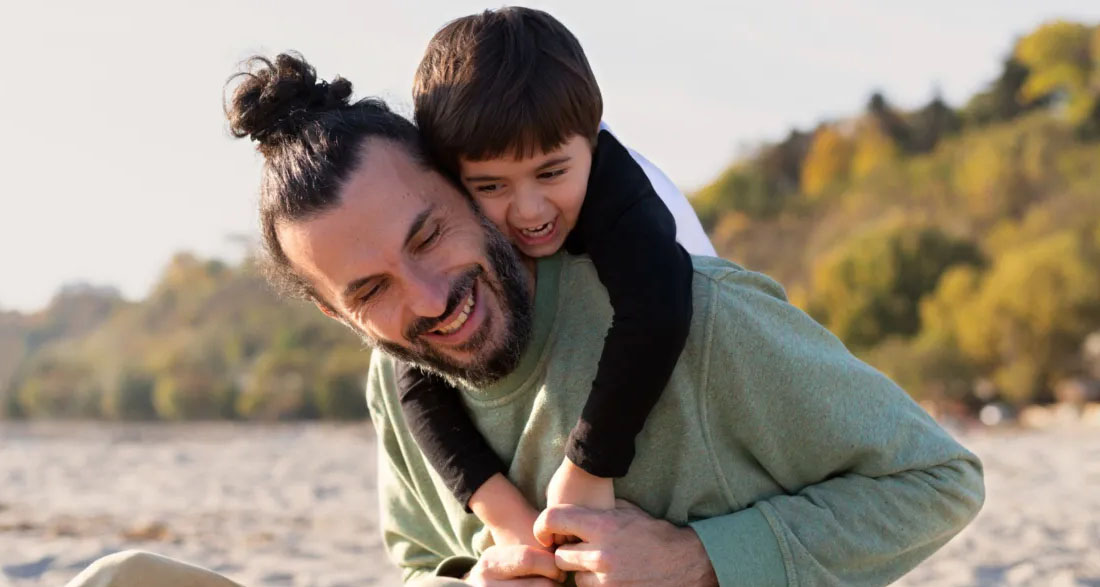
My dad was my Superman. Not because he could fly or lift cars, but because he showed up—every single day of my life. I didn’t realize just how much that meant until the day after his funeral, when a stranger knocked on my door and shattered everything I thought I knew. My whole life, I believed I understood my hero… but I was only half right.
My dad, Kevin, was my hero. He made pancakes on Saturdays. Not just any pancakes—he’d flip them high in the air and pretend to fumble, just to hear me laugh. Even when we didn’t have much money, he somehow made our tiny apartment feel like a palace.
He showed up to everything. Parent-teacher meetings, where he’d sit in the too-small chair, nodding seriously while my teacher talked about my math homework. Baseball games, where he arrived straight from his second shift, still in work boots, clutching a thermos of coffee, cheering louder than anyone else in the stands.
When I was seven, I had nightmares about monsters under my bed. Dad would come in at two in the morning, sit on the edge of my mattress, rubbing circles on my back until I stopped shaking.
“Breathe with me, Brian,” he’d whisper. “In and out. That’s it. I’ve got you, buddy.”
I believed him. Because he always did.
Other kids had two parents sharing the work. I had one man doing the job of both. He packed my lunches with little notes tucked inside:
“Proud of you. You’re gonna do great today. Love you, kiddo.”
I kept every single one in a shoebox under my bed.
Mom died when I was a baby. I never knew her. Dad said she was beautiful and kind, and that I had her eyes. He kept one photo of her on the mantle but rarely talked about her.
“It’s just you and me, buddy,” he’d say, ruffling my hair. “And that’s more than enough.”
“Dad, do you ever get lonely?” I asked once when I was twelve.
He looked at me with those steady brown eyes. “How could I be lonely when I’ve got you, sweetie?” He pulled me close and kissed the top of my head. “Brian, some people spend their whole lives searching for what matters. I’ve already found it. You’re everything I need.”
I didn’t understand what he meant back then.
Then he was gone.
The call came on a Tuesday. I was stocking shelves at the grocery store when my manager pulled me aside. His face said it all before he spoke.
Construction accident. My dad, working downtown, had fallen from scaffolding. The hospital tried, but he didn’t make it.
One second, my dad existed. The next, he didn’t.
The funeral was three days later. I wore his old tie—the navy one with thin gray stripes. He’d taught me how to knot it when I was sixteen.
“There you go,” he’d said, beaming. “You’ve got the look of a man who’s ready for anything.”
I stood at his casket, feeling like the air had been sucked out of my lungs. People kept saying he was in a better place, but I didn’t want him in a better place. I wanted him here. More Saturday pancakes. More baseball games. More notes in my lunchbox.
Dad’s construction crew came, red-eyed and silent. His foreman put a hand on my shoulder.
“Your dad talked about you every single day,” he said. “You were his whole world, kid.”
It somehow made it worse. When it was over, I walked into a house that felt too quiet, too empty. His work boots still sat by the bed, caked with dirt from his last shift.
“Dad?” I whispered, my voice breaking in the silence.
I must have fallen asleep on the couch, still in funeral clothes. The doorbell woke me the next morning, shrill and urgent.
At first, I ignored it. Then it rang again. And a third time.
I dragged myself to the door. A woman stood there, maybe in her mid-40s, pale and exhausted, her hands clutching a purse strap so tightly her knuckles were white.
“Are you Kevin’s son?” she asked.
“Yeah… I’m Brian,” I said.
“My name’s Ella. I’m your father’s sister.”
I froze. “Dad didn’t have a sister.”
“Yes, he did. We were estranged. For a long time. But I need to talk to you, Brian. Your father isn’t who you think he was. Kevin owed me money. A lot of it. I helped him with the adoption fees. He promised he’d pay me back.”
“Adoption fees? What are you talking about?”
“Can I come in? This isn’t a conversation for the doorstep.”
I should have slammed the door. Instead, I stepped aside.
Ella sat on the edge of the couch. I stood, arms crossed, waiting.
“Kevin borrowed $15,000 from me 18 years ago—for legal fees, paperwork, agency costs. He said he’d pay me back within five years, but he never did.”
Something felt wrong. Dad never owed anyone money. And he’d never mentioned a sister.
“Do you have proof? Paperwork? Anything?” I asked.
“It was a family arrangement. No contracts.”
“Then how do I know you’re telling the truth? How do I know you’re really his sister?”
“Because I know things,” she snapped. “Things about Kevin. About you.”
“Like what?”
Her face hardened. “Like the fact that you’re not even his real son.”
The words hit like a punch to the chest.
“What did you just say?”
“You’re adopted, Brian. Kevin wasn’t your biological father. And now that he’s gone, I want what I’m owed.”
Heat flooded my face.
“GET OUT.”
“Excuse me?”
“I said get out! You show up the day after I bury my father, make up a story about money, and now… and now you tell me I’m not his real son?”
“It’s not a lie!” she shouted, standing. “None of it is! Eighteen years ago, there was a car accident. A rainy night. Two cars collided. Kevin’s wife was in one. A young couple in the other. Everyone died.”
Every part of me locked up.
“But there was a baby in the other car,” she continued. “A baby in a carrier. The impact threw the carrier out. That baby… was you.”
I sank into a chair, my legs trembling.
“No. That’s… that’s not true. You’re lying.”
“I’m not,” she said, handing me a folded document. Adoption papers. My name, Kevin’s name, eighteen years ago.
“Your father owed me money for helping with legal fees,” she added softly. “Fifteen thousand dollars. I came to see if…”
“You don’t have proof,” I shouted, standing. “You show up with papers, tell me my life’s a lie, and want money on your word alone?”
“Brian…”
“Please. Just go.”
She stood slowly. “I’m sorry. I handled this all wrong. Your father loved you more than anything. That part was never a lie.”
Even through shock, one thought pushed through: Dad had chosen me. Even after losing everything, he had chosen me.
I sat in his chair, replaying every memory—Saturday pancakes, baseball games, lunchbox notes, bedtime reassurances. He didn’t owe me anything. He had lost his wife, unborn child, and future. And still, he chose to save a stranger’s baby. To raise me. To love me.
I grabbed his baseball jersey and drove to the cemetery. Grass fresh over his grave, headstone simple: Kevin. Beloved Father.
I collapsed beside it, clutching the jersey.
“You didn’t owe me anything,” I whispered. “You could’ve walked away. But you didn’t.”
Tears ran down my face. “You gave me everything. You showed up. You loved me. You were my hero.”
I pressed my forehead against the cold stone. “I don’t care whose blood I carry. You’re my father. Always.”
I laid his jersey across the grave like a blanket.
“You said it was just you and me. And that was more than enough. You were right, Dad. It was everything.”
The wind rustled the trees.
“I used to think Mom dying was the worst thing that ever happened. But now I know—you turned the worst night of your life into the best thing in mine.”
I wiped my face and stood.
“I’m gonna be okay, Dad. Because of you, I know how to be strong. I know how to show up. I know what love really means.”
I touched the headstone one last time.
“See you later, Superman.”
Then I walked away, carrying his jersey, knowing some legacies aren’t written in blood—they’re written in love, sacrifice, and choosing to be there when it matters most.
Turns out, my life wasn’t a lie. It was built on a love so real it rewrote the truth.
Some legacies aren’t written in blood.