

A lifetime of putting work first had slowly pushed Tom away from the people who once mattered most to him. Now, nearly 70 years old, his health was getting worse, his house felt emptier every day, and his daughter barely spoke to him anymore after years of feeling forgotten.
He told himself he still had time to fix things—but an unexpected Christmas scare would force him to face the truth and make a choice that could change everything.
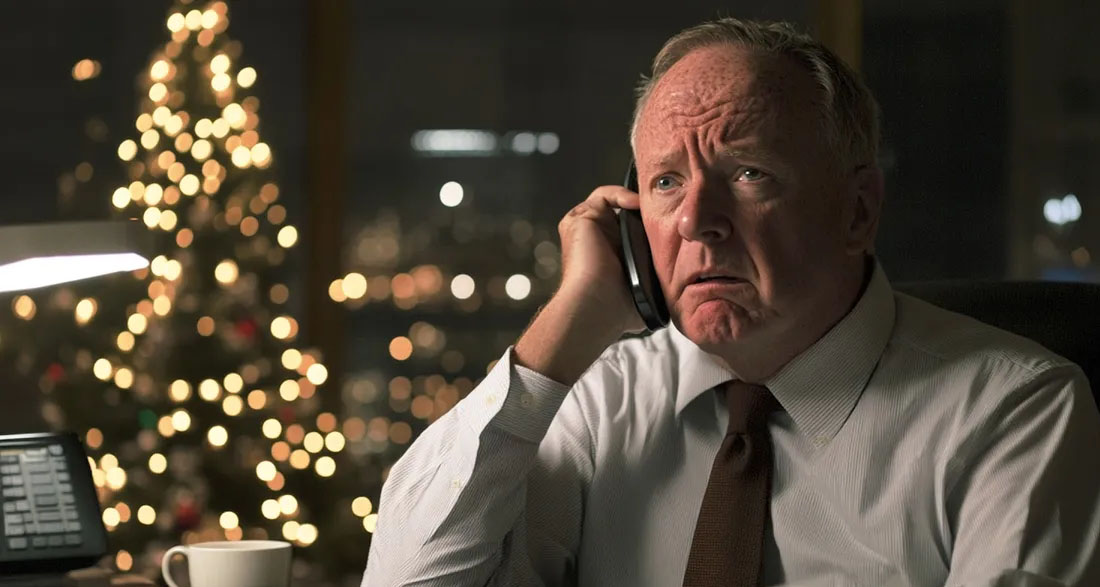
Tom sat alone in his quiet office late one evening.
The building was almost empty, and the only sound was the low hum of the heater fighting the winter cold. His desk was perfectly organized, papers stacked neatly, pens lined up just right. Yet his tired eyes kept drifting to the small Christmas tree glowing softly in the corner of the room.
The lights blinked gently, cheerful and warm, but in that lonely space, they felt out of place. Tom always stayed late, long after everyone else had gone home. Work had become his routine, his comfort, his excuse.
Most of his friends had retired years ago. They talked about travel, grandchildren, and lazy mornings. Tom listened politely, but work was his anchor. Without it, he didn’t know who he was.
With a heavy sigh, he picked up his phone and scrolled to his daughter’s name. Daisy. His finger hovered for a moment before he finally pressed call.
“Hello,” Tom said when she answered, his voice calm but uncertain.
“Hi, Dad,” Daisy replied. She sounded distracted, like she was doing three things at once.
Tom swallowed. “So… what does Theo want for Christmas this year?” he asked, trying to sound casual.
“He wants a Furby,” Daisy said.
“A Furby?” Tom repeated, frowning. “What’s that?”
“It’s a toy,” Daisy explained patiently. “It talks and moves. All the kids at school have one.”
Tom hesitated. “Would it be okay if I just gave him money instead?” he asked carefully.
There was a pause. “Uh… yeah, I guess,” Daisy replied, her disappointment clear. A second later, the call ended.
Tom stared at the phone for a long moment. He knew he’d said the wrong thing, but he didn’t know how to fix it.
After working a bit longer, he gathered his things. His desk, once crowded with files and buzzing with phone calls, now looked too clean. Too empty. Locking the office behind him, he stepped into the cold night air and drove home, the radio playing softly. He didn’t really hear it.
When he walked into his house, the silence greeted him like an old, unwanted companion. He hung his coat by the door and stood still, looking at the dim living room. The same couch. The same TV. The same quiet.
He’d lived like this for years, ever since his wife had packed up and left, taking Daisy with her. Back then, he told himself it was temporary. That work needed him. That family would understand.
They hadn’t.
Tom changed into his worn sweatpants and sat heavily on the couch, remote in hand. As the TV flickered on, his eyes drifted to a shelf across the room. A framed photo sat there—Theo, smiling wide, missing a tooth.
Tom’s chest tightened. That little boy barely knew him.
The next morning, Tom drove to the clinic. Sitting in the waiting room, he already knew what the doctor would say. Slow down. Work less. Take care of yourself.
Dr. Harris entered the room with a clipboard. “Well, Tom, how are you feeling today?” he asked, taking a seat.
“I’m fine,” Tom muttered, staring at the floor.
Dr. Harris flipped through the file. “Your tests are mostly okay, but your cholesterol is still too high. We’ve talked about your diet. Are you eating better?”
“No. I ignore it,” Tom said, crossing his arms.
Dr. Harris sighed. “Tom, you can’t ignore this. You know your heart condition. You need to make changes.”
“I drink water,” Tom said defensively, holding up a bottle. “My daughter sent it. Says it’s fancy.”
“That’s good, but it’s not enough,” Dr. Harris replied. “Have you told your family about your condition?”
“No.”
“Tom, they need to know.”
“I wasn’t a good father,” Tom admitted quietly. “I don’t want to drag her into this.”
“Are you afraid she won’t help?” Dr. Harris asked gently.
Tom shook his head. “I’m afraid she’ll help too much.”
Dr. Harris stood. “Tom, you have to tell her. Or I will.”
“You’re supposed to make my life easier, Doc,” Tom said with a weak smile.
“I’m trying to keep you alive,” Dr. Harris replied, giving his shoulder a firm pat before leaving.
That evening, Tom sat in his armchair, phone heavy in his hand. Daisy’s name glowed on the screen. His thumb hovered.
Finally, he pressed call.
“Dad?” Daisy answered, surprised.
“We need to talk,” Tom said softly.
“What’s wrong?”
He told her everything. About his heart. About the doctor. About being scared.
There was silence. Then Daisy said, “I’m coming tomorrow. I’ll take care of it.”
“You don’t have to—” Tom started.
“I’ll see you tomorrow,” she said firmly.
The next day, Daisy arrived like a storm. She called the doctor, asked a hundred questions, then cleaned out his fridge.
Later, she sat across from him. “Andrew and I talked,” she said. “We want you to come live with us. You’d have your own space. We’ve already found a great doctor.”
Tom shook his head. “Thank you, Daisy. But I can’t.”
“Why?” she demanded.
“Because I need to work.”
Her eyes flashed. “Dad, you’re almost 70!”
“Work is all I have,” Tom said quietly. “I don’t know who I am without it.”
Daisy’s voice shook. “What about me? What about Theo? You missed my whole childhood. And Theo doesn’t even know you!”
“I’m sorry,” Tom whispered.
“I’m done,” Daisy said, grabbing her bag and slamming the door.
For two weeks, Tom called every day. No answer. When Dr. Harris told him his condition had worsened, Tom knew he couldn’t wait anymore.
The day before Christmas, his phone rang.
“This is Riverside Health Clinic,” a voice said. “We’ve received Mrs. Brown’s body following an accident. You’re listed as the emergency contact.”
Tom’s heart stopped. Daisy.
Later, at the hospital, he learned it was a mistake. Wrong Brown. Wrong daughter.
Relief crashed over him, followed by shame. What if next time it wasn’t a mistake?
Two hours later, Tom stood at Daisy’s door in a Santa costume, holding a Furby. He rang the bell.
“Dad?” Daisy whispered.
“Merry Christmas,” Tom said. “I know I failed you. But I want to change.”
Daisy’s eyes filled with tears. “Come in, Dad.”
“Theo!” she called. “Look who’s here!”
Theo ran toward him. “Santa!”
Tom dropped to his knees, hugging his grandson tightly, tears streaming down his face as Daisy watched, hope finally warming the room.