

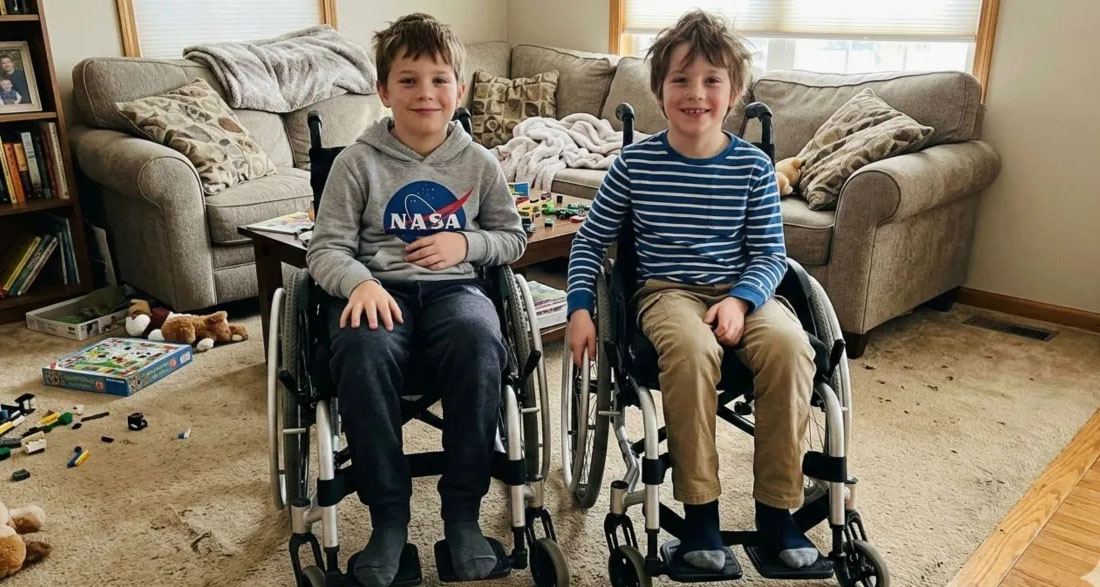
I thought my husband was working endlessly to secure a better future for our disabled sons. I didn’t know that the truth about his “late nights” would lead to a reckoning he never expected—and it would be led by the one person who could truly change everything.
I used to measure my days by my sons’ medications.
Seven in the morning meant giving Lucas his muscle relaxants. Fifteen minutes later, it was Noah’s seizure medication. By 8 a.m., it meant stretching exercises before breakfast, balancing plates, syringes, and wheelchairs.
By 9 a.m., I already felt like I had run a marathon.
Three years ago, my world had turned upside down. Lucas and Noah, my twin boys, had been in a car accident while my husband, Mark, drove them home from school. They survived, but the crash left Lucas barely able to move his legs, and Noah with constant brain trauma.
Our lives shifted overnight.
Physical therapy appointments, wheelchairs, bath chairs, adaptive utensils, lifting two growing boys who depended on me for everything—it became my life.
The boys survived. And I loved them more than anything. But caring for them was exhausting in ways I never imagined. Most nights, I slept in short bursts—three hours, maybe four if I was lucky.
Meanwhile, Mark always seemed to be “at work.”
He worked at his father Arthur’s logistics company. Arthur had built it from nothing, and Mark had spent years telling everyone that he would one day run it.
Whenever I expressed how overwhelmed I felt, Mark said the same thing:
“Just hold on a little longer, Emily. Once I become CEO, everything will change. We’ll hire full-time nurses. You won’t have to do all this alone.”
I believed him.
For a while, it made sense. Arthur was nearing retirement, and Mark was the obvious successor. Long hours seemed like the price of ambition.
But after the accident, those hours stretched endlessly. “Just hold on a little longer.”
His “late meetings.” Weekend “client dinners” that went until midnight.
At first, I tried to support him, but the cracks were showing.
One evening, about six months before everything exploded, Mark came home smelling of expensive perfume.
I stood in the kitchen holding Noah’s feeding syringe.
“That’s a new cologne,” I said cautiously.
“It’s a client dinner, Emily. Restaurants smell like perfume. Relax,” he replied casually.
I wanted to believe him. But little things kept piling up—receipts for hotels when he said he’d stayed late at the office, phone alerts face-down on the table, the way he stopped really looking at me.
I had dark circles under my eyes, wrinkled clothes from lifting the boys all day, hands faintly smelling of antiseptic. He noticed.
Last Wednesday became the breaking point.
I’d thrown out my back helping Lucas transfer from his wheelchair to the couch, but I still cooked breakfast and helped Noah with speech exercises. Then Lucas slipped in the bathroom.
He was on his shower chair, holding the safety rail, adjusting the water. His arm slipped, the chair tilted, and he slid sideways onto the floor.
“Mom!” he cried.
I tried to lift him, but my back screamed. I grabbed my phone and called Mark. No answer. Seventeen calls later—straight to voicemail.
I called my neighbor, Dave, who rushed over. Together, we lifted Lucas into bed. All the while, my son sobbed and whispered, “I’m sorry, Mom. I’m sorry.”
I kissed his forehead and forced a smile. “You did nothing wrong, sweetheart.”
Inside, I was falling apart.
Mark finally walked in at 10 p.m., as if nothing happened.
“Long day,” he muttered.
I stared at him. “I called you seventeen times!”
He shrugged. “I was in meetings.” Then he disappeared into the shower.
That’s when his phone lit up on the bedside table. The message preview—before I could stop myself from reading it—showed the contact name: Jessica (Client).
“That hotel view was almost as good as you. Can’t wait for our weekend trip.”
Jessica was not a client. She was Mark’s 22-year-old secretary. My hands started shaking.
When he came out of the bathroom, I held up his phone.
“Who is this Jessica?”
He looked annoyed, then sighed. “You really want the truth?”
“Yes.”
“It’s Jessica, my secretary. We’ve been seeing each other.”
The words hit harder than the car crash ever had.
“What about your family? Your sons?” I asked quietly.
“They’re still my sons,” he said, almost defensively.
“You haven’t been home before midnight in weeks.”
“We’ve been seeing each other.”
He rolled his eyes. “Emily, look at you. You always smell like antiseptic. You’re exhausted all the time. You never want to talk about anything except medications and therapy schedules.”
“I’m raising our children,” I said, my voice trembling.
“And I’m trying to build a future,” he snapped. Then, cruelly, “You’re just not appealing anymore.”
I said nothing. That night, we slept in separate rooms. For the first time in years, I realized our marriage might already be over.
Two days later, Mark’s father, Arthur, came to visit the boys. He sat on the living room floor as Lucas demonstrated how he could move his leg a few inches with a resistance band. Arthur clapped as if Lucas had just won a gold medal.
“Look at that strength!” he said proudly.
Lucas beamed.
I couldn’t bear watching Arthur treat them better than their father, so I retreated to the kitchen.
Arthur found me crying.
“Emily,” he said gently, “what’s wrong?”
I spilled everything—the affair, hotel messages, insults, the accident with Lucas. His face went cold.
“Tomorrow morning, I’m calling Mark at headquarters at 8 a.m.,” Arthur said. “I’ll tell him he’s finally becoming CEO. But what happens next… oh God, it’s going to be a big show. He’ll regret everything he did. Be there. Please come and see.”
The next morning, I stood outside Arthur’s office. Through the closed door, I could hear voices: Arthur calm, Mark excited.
Arthur revealed later what happened. After announcing Mark as the new CEO, a large conference screen displayed several documents: hotel invoices and expense reports—every single one under Mark’s name.
Four luxury hotels in three months, two weekend spa packages, plane tickets for him and Jessica. All submitted as “client meetings.”
Mark’s mouth opened and closed.
“You set me up!” he finally screamed.
Arthur raised an eyebrow. “No, Mark. I gave you an opportunity. This meeting was meant to give you one last chance to tell the truth in front of the board.”
Mark’s breathing became heavy. Then Arthur said the words that changed everything:
“As of this morning, you no longer work here. Your shares will be transferred into a medical trust. My grandsons require lifelong medical care. That trust will fund their treatment and hire full-time nurses.”
Mark’s face twisted with fury. “You’re giving my company to them?”
Arthur shook his head. “It was never your company.”
At exactly 8:00 a.m., Mark screamed. Something heavy hit the floor. I rushed in. A laptop lay shattered. Executives were stunned. Security guards appeared.
“You’re destroying everything!” Mark ranted. “I was finally going to live my life! Jessica and I were going to start fresh! I was going to move the boys into a state facility so Emily could stop dragging me down!”
I stepped forward. “Wait. I want to say something.”
Mark stared at me, frozen.
“I actually came here to help you. I planned to ask Arthur to give you an entry-level job so you could stay involved in Lucas and Noah’s lives. They deserve a father.”
He said nothing.
“But after hearing what you just said about putting them in a facility… I won’t do that anymore. I’m divorcing you, Mark.”
Arthur nodded once.
Mark turned to him angrily. “You’re siding with her?”
“I’m siding with my grandsons,” Arthur said firmly. He opened a folder. “I’m prepared to adopt Lucas and Noah legally. You will relinquish all parental rights.”
Mark swayed, then collapsed. Paramedics arrived minutes later. He was conscious, likely stressed and dehydrated. Jessica faced consequences too—demoted to a basic administrative role far from leadership offices.
Within two weeks, the medical trust was finalized. Three licensed nurses began rotating shifts at our house. For the first time since the accident, someone else monitored the boys.
One evening, I watched a nurse help Lucas with standing exercises. Someone knocked. Arthur stepped in.
“You look rested,” he said.
“I slept six hours last night,” I said.
He chuckled. “That’s a luxury. Those two are the future of my family.”
A month later, I boarded a train to a quiet spa resort two hours away. The nurses had everything under control, and Arthur insisted I take a weekend for myself.
As the train pulled away, I leaned back and closed my eyes. For the first time in three years, I felt something I had almost forgotten: peace. I looked out at the fading sunset and smiled. Our future felt hopeful again.