

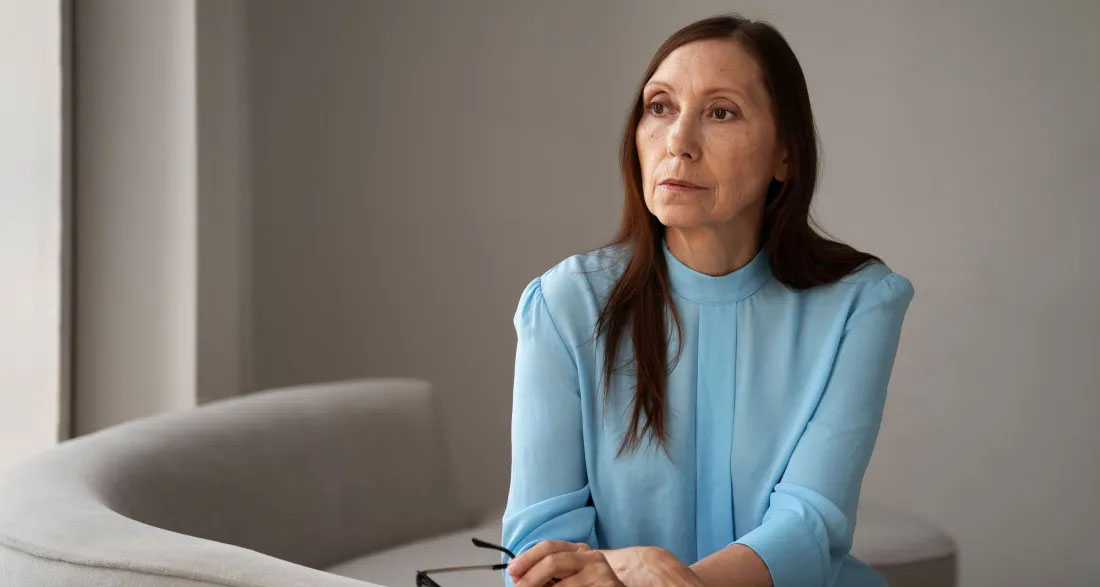
For seven years, my life was filled with silence. No answers. No clues. Just the heavy, painful question that never left my heart: What happened to my daughter?
Then one ordinary day, in a crowded coffee shop far from home, I saw a bracelet that stopped me cold and changed everything.
I was 45 years old when Christmas stopped feeling like something joyful. From that moment on, Christmas became something I simply endured. Something I survived.
Before that, I loved everything about the season.
I loved the way snow softened the world and made everything feel quiet and safe.
I loved the smell of cinnamon bubbling on the stove.
And most of all, I loved how my daughter, Hannah, used to sing Christmas songs completely off-key, just to make me laugh.
She never cared if she sounded bad. She’d grin at me and say, “It’s more fun when it’s loud.”
I used to love everything about Christmas.
I am 52 now.
Hannah disappeared seven years ago. She was only 19.
That night is burned into my memory. She told me she was going out to meet a friend. She grabbed her jacket, called out, “I won’t be late,” and walked out the door.
She never came back.
She didn’t leave a note.
She didn’t call.
She didn’t text.
The police searched. They asked questions. They followed leads that went nowhere. They never found a body, which somehow hurt even more. Because without a body, there was no ending. Just endless waiting.
My daughter vanished without a trace.
For months afterward, I barely slept. Two hours at a time, if I was lucky. Every noise made me sit up in bed. Every ringing phone made my heart race.
I kept Hannah’s room exactly the way she left it. I didn’t move a thing. Her favorite hoodie still hung on the chair. Her shoes were still by the door. Her perfume — that clean, lemony scent — lingered in the closet long after it should have disappeared.
Part of me believed that if I kept everything the same, she might walk back in and say, “Mom, why did you move my stuff?”
I lived in limbo — stuck between grief and denial. Between hope and heartbreak.
One winter morning, seven years later, I was traveling home after visiting my sister, Margaret. I had a long layover in a city I didn’t know, so I wandered into a small coffee shop near the train station to kill time.
The place was busy and warm, full of noise and life. It should have felt comforting, but instead it made the emptiness inside me feel even louder.
Mariah Carey’s Christmas music was playing too loudly.
A couple laughed at a corner table, clinking their mugs.
Someone spilled hot cocoa and laughed about it.
Everyone was happy.
I ordered a latte I didn’t even want and stood near the counter, staring at the Christmas lights in the window. I wasn’t planning to sit down. I just needed time to pass.
Then the barista slid my drink toward me.
As I reached out to take it, something caught my eye.
A bracelet.
On the barista’s wrist was a thick, hand-braided bracelet made of faded blue and gray threads. It was tied with a small, crooked knot instead of a clasp.
My breath left my body.
I recognized it instantly.
It was the bracelet — the one Hannah and I made together when she was 11 years old. We made it one snowy afternoon at our kitchen table. She had insisted on weaving it herself, tongue sticking out as she focused.
When she tied the knot, it came out crooked. She laughed and said, “That makes it special.”
She wore that bracelet every day.
Even on the night she disappeared.
My hands began to shake so badly the cup almost slipped from my fingers.
“Excuse me,” I said, my voice barely louder than a whisper. “That bracelet… where did you get it?”
He blinked. “Sorry?”
I pointed to his wrist. “The blue and gray one. Where did you get that bracelet?”
He looked down at it, then back at me. For just a second, I saw something flash across his face — fear, maybe. Discomfort.
“It’s mine,” he said quickly. “I’ve had it for a while. It’s personal.”
Then he pulled his sleeve down to cover it.
That’s when I knew he was lying.
My heart pounded so hard I thought I might faint. I leaned against the counter.
“I made that bracelet,” I whispered. “With my daughter.”
He swallowed. “I don’t know anything about that,” he said, turning away. “I can’t help you.”
But I couldn’t leave.
I sat in a corner booth and waited. I didn’t touch my coffee. I just watched him. Hours passed. The shop slowly emptied. The sun dipped low.
When his shift ended and he grabbed his coat, I stood in front of the door.
“Please,” I said, blocking his path. “Just listen. My daughter’s name is Hannah.”
The color drained from his face.
“She disappeared seven years ago,” I said, my voice breaking. “I just want to know if she’s alive.”
He tried to step around me, but I broke down. Right there between the tables, I started sobbing — loud, messy sobs that turned heads. I hadn’t cried like that in years.
He froze.
“I didn’t steal the bracelet,” he finally said quietly. “She gave it to me.”
Everything inside me went still.
“You know her?” I gasped. “Is she okay? Where is she?”
He hesitated, then pulled out his phone. “Give me your number. I’ll call you.”
That night, I didn’t sleep at all. I stared at my phone in a hotel room, jumping at every sound. The next day passed. Then another.
I started to think I had imagined everything.
Then my phone rang.
“I talked to her,” he said. “Hannah doesn’t want to talk to you.”
My heart shattered.
“Why?” I whispered.
“She felt like she couldn’t breathe,” he said gently. “She said you were always on her case.”
Then he added, softly, “She was pregnant when she left. She was afraid you’d never forgive her.”
My knees gave out.
“She wanted a clean slate,” he continued. “She changed her name. We met a few months later. My name’s Luke. We’re married. We have two kids.”
“She’s alive,” he said. “She’s strong. She’s a good mom.”
I cried and laughed at the same time.
A week later, my phone rang again.
“Hi… it’s me,” a voice said. “It’s Hannah.”
I dropped the phone and sobbed.
When I called back, she answered.
“Hi, Mom.”
“I’m so sorry,” I said.
“I’m sorry too,” she whispered.
We met in a park on a cold, sunny morning. When I saw her pushing a stroller, holding a little girl’s hand, I forgot how to breathe.
She hugged me first.
“Hi, Mom.”
I clung to her like she might vanish again.
Later, she untied the bracelet and smiled. “The crooked knot still makes it special.”
That Christmas, I sat in her living room, surrounded by laughter and cinnamon and falling snow.
Hannah leaned her head on my shoulder.
“Thank you for waiting,” she said.
“I never stopped,” I whispered.
And for the first time in seven years, Christmas felt warm again.