

When Love Returns
When Daniel asked me to marry him, I thought I’d already survived the hardest parts of grief. I’d buried my husband, raised our kids mostly on my own, and somehow learned to live again. I said yes, believing the worst was behind me.
But on our wedding night, when Dan stood in front of an old safe, hands trembling, whispering words that cut through the quiet of our new life together, I realized I still didn’t understand everything about loyalty, love, or second chances.
I’m forty-one now, and there are still mornings when I wake up and can’t quite believe this is my life.
For twenty years, I was Peter’s wife. Not in some romantic movie kind of way, but in the real sense—the kind of life you build through ordinary moments that somehow become everything.
We had a four-bedroom colonial with a stubborn porch that was always half-fixed and floors that creaked like old bones. We raised two kids who left messes, slammed doors, and filled the air with laughter.
My daughter is twenty-one now, off at college across the country—as far east as she could go. My son’s nineteen, studying engineering out west.
They’ve stretched their wings in opposite directions, and I’m proud of them. But the house feels too quiet now. Too still. The walls seem to be waiting for voices that aren’t coming back. It’s strange how silence can weigh you down.
Peter used to call our life “ordinary,” and he meant it as the highest compliment. Ordinary meant steady. Safe. Predictable. He loved fixing things himself—even if half the time, he made it worse.
I’d pretend to be annoyed, but secretly, I watched his brow furrow in concentration. He wasn’t perfect. Stubborn, messy, too quiet when I needed him to talk. But he was mine. And he made me feel safe in ways I didn’t understand until that safety disappeared.
Six years ago, a drunk driver ran a red light. Peter was coming home from work. A police officer showed up at my door that night, and when I saw his face, I knew. My knees gave out. I collapsed on the porch, screaming, while my world shattered into pieces.
What came after barely feels real now—like watching someone else’s life unravel. My daughter cried behind a locked bathroom door. My son punched walls and refused to speak.
I would wake at two in the morning, wandering into the kitchen, staring at Peter’s coffee mug still sitting by the sink, unable to touch it. Everything hurt.
And then there was Dan.
Daniel had been Peter’s best friend since they were kids—three houses apart, thick as thieves. They shared a thousand bad ideas and too many inside jokes. A road trip across the country at twenty-two had them sleeping in their car, living on gas station food. They were more like brothers than friends.
Dan had been through storms of his own. A failed marriage, a messy custody battle, a daughter he adored but didn’t see enough. He never complained, never blamed anyone. I’d always admired that—his quiet strength, the way he refused to badmouth anyone even when he was hurting.
When Peter died, Dan just showed up. He didn’t ask what I needed or wait for an invitation. He fixed the garbage disposal Peter had been putting off.
He brought groceries when I forgot to shop. He sat with my son in the garage for hours, handing him tools while the boy took his grief out on old scrap wood.
“You don’t have to keep doing this,” I told him one evening as he changed a lightbulb.
He didn’t even look down from the ladder. “I know,” he said. “But Pete would’ve done it for me.”
And that was it. No speech. No expectations. Just loyalty.
Healing is strange—it happens quietly. You barely notice it at first.
Three years after Peter’s death, my kids were finally finding balance again. I was learning how to be something other than “the widow.” Dan had pulled back a little, giving me space, but one night, around eleven, my kitchen sink started leaking. Without thinking, I called him.
Twenty minutes later, he arrived in sweatpants and an old college T-shirt, toolbox in hand.
“You know, you could’ve just turned off the water and called a plumber tomorrow,” he said, kneeling under the sink.
“I could’ve,” I said, leaning against the counter. “But you’re cheaper.”
He laughed, and it felt like the first real laugh I’d had in months. Something shifted then—small, invisible, but real.
After that, we slipped into something easy. Coffee on Sunday mornings. Movies on Friday nights. Conversations that lasted until the moon disappeared. He never pushed, never flirted, never made me feel like I owed him anything. But there was something fragile and unspoken between us.
My daughter noticed first.
“Mom,” she said one afternoon, “you know Dan’s in love with you, right?”
I almost choked on my coffee. “What? No. We’re just friends.”
She rolled her eyes. “Mom. Come on.”
It took weeks to admit it to myself. The guilt was heavy. How could I think about someone else when Peter was gone? But grief isn’t a straight line. It doesn’t end. It changes shape.
Dan waited. He never said a word until one evening on my porch, as the sun dipped low and the air smelled like summer rain.
“I need to tell you something,” he said, staring at the yard. “You can tell me to leave and never come back if you want. But I can’t keep pretending.”
My heart raced.
“I’m in love with you, Isabel,” he said, voice cracking. “I know it’s wrong. He was my best friend. But I can’t help it.”
I should’ve been shocked. But deep down, I’d known.
“It’s not wrong,” I whispered. “I feel it too.”
He looked at me, eyes full of tears. “Are you sure? Because I can’t be another loss for you. I can’t be a mistake.”
“I’m sure.”
And that was it. No drama, no hesitation. Just truth.
We kept it quiet at first. My kids were the first to know. My son shook Dan’s hand and said quietly, “Dad would’ve wanted you to be happy, Mom.” My daughter cried and hugged us both.
Telling Peter’s mother terrified me. I expected anger, disappointment, something sharp. But when I told her, she only smiled sadly.
“You’re with Daniel,” she said before I even began. “I have eyes, sweetheart. Peter loved you both. If he could choose someone to take care of you, it would be him.”
I started to cry.
“You’re not betraying him,” she said. “You’re living.”
And so, we did.
Dan proposed one evening in my kitchen, the same place he’d fixed the sink years ago.
“I can’t promise perfect,” he said, down on one knee. “But I can promise I’ll love you for the rest of my life.”
“That’s all I need.”
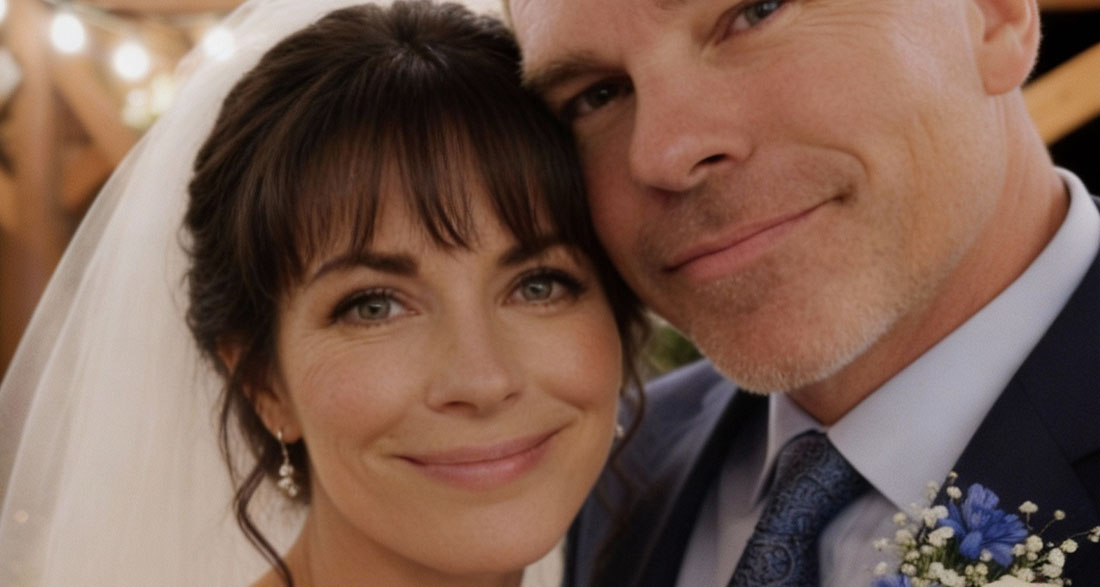
The wedding was simple and warm—fairy lights in the backyard, chairs borrowed from neighbors, our families laughing together. I wore a cream dress, nothing fancy. Dan’s vows made me cry.
“I promise to honor the man who brought us together,” he said. “I promise to love you the way you deserve, and to be the kind of man he’d be proud of.”
That night, after everyone left, we drove home hand in hand. I felt light. Hopeful. Whole.
But when I came out of the bathroom, wiping off my makeup, Dan wasn’t smiling. He stood in front of the safe in our closet, shoulders stiff, hands trembling.
“Dan?” I said gently. “What’s wrong?”
He didn’t move. Didn’t turn.
Finally, he faced me, eyes full of fear. “There’s something I have to show you. Something you need to read before tonight.”
I felt the air shift. “What are you talking about?”
He entered the code, and the safe door swung open. He pulled out an old phone—cracked screen, taped battery, worn from years of use.
“My daughter found this a few weeks ago,” he said. “I charged it, and I found something I forgot existed.”
It was a message thread between him and Peter—from seven years ago. At first, harmless: football jokes, beer plans. Then Dan’s words made my chest tighten:
Dan: Sometimes I look at what you have and wonder if I’ll ever get that lucky. You and Isabel just work. You’re lucky, man.
Peter: Don’t. Seriously. Don’t go there. Promise me you’ll never try anything with her. She’s my wife. Don’t cross that line.
I felt the blood drain from my face.
“I’d forgotten all about it,” Dan said. “My marriage was ending then. I was miserable. I watched you and Pete together and said something stupid. I never planned anything. I never crossed that line.
You were his wife. I’d never…” His voice broke. “When I found this phone, I felt sick. I thought maybe I’d been fooling myself—maybe I’d broken a promise without realizing it.”
He sank onto the bed, burying his face in his hands. “What if I used your grief? What if I took advantage of you? Tell me the truth, Isabel. Do you think I did?”
My heart ached. This man had shown up when the world fell apart, and now he doubted himself.
“Do you love me?” I asked.
“Yes,” he said instantly, eyes shining. “God, yes.”
I knelt beside him, took his face in my hands. “Then that’s all that matters. Peter didn’t plan to die. He didn’t know what life would look like after. And if he could see us now, he wouldn’t be angry. He’d be grateful. You didn’t break a promise, Dan. You kept one—you took care of me when I needed it most.”
Tears rolled down his cheeks.
“You didn’t take advantage,” I said softly. “We both lost him. We both grieved. We both survived. That’s what this is—survival. It’s love, the kind that grows out of pain and still finds a way to be beautiful.”
He let out a shaky laugh. “I was so scared to tell you.”
“I know,” I said. “And that’s why I trust you.”
We kissed—not fiery, not cinematic—but quiet, real, full of forgiveness. That night, instead of a honeymoon, we shared honesty. We made new promises—not based on what we lost, but on what we still had.
That was two months ago.
Now, every morning when I wake up and Dan’s arm is draped across me, I feel peace. Not the easy kind, but the kind you earn—built out of pain, truth, and forgiveness.
Peter will always be part of my life. He gave me twenty years of laughter, two wonderful children, and the strength to keep going when everything broke. But he isn’t my whole story. Dan is the next chapter.
Grief doesn’t erase love. Love doesn’t erase grief. They live together, side by side, tangled but whole.
If there’s one thing I’ve learned, it’s that the heart is stronger than we imagine. It can break into a thousand pieces and still beat again. It can love more than once, deeply and truly, without guilt.
I’m forty-one. I’ve been both a wife and a widow. I’ve buried someone I adored and married someone who helped me breathe again. Life is messy. But sometimes, the mess is where the beauty hides.
Because real love isn’t about starting over. It’s about continuing on. And somehow, against all odds, that’s exactly what we did.