

I’m the maintenance guy everyone in this fancy gated community pretends not to see. Most days I sweep their sidewalks, unclog their drains, and sleep in a tiny storage room behind the maintenance office.
People whisper about me—call me “dangerous,” “creepy,” or even say I’ve been to prison. None of it’s true. I’m just… quiet. Until one cold morning, everything changed.
My name’s Harold. I’m 56, and I live where I work. Not in a house. Not in a proper apartment. In a storage room that smells faintly of mop buckets and disinfectant.
There’s a metal door, one cot, a hot plate I’m not supposed to have, and enough space to barely stretch my arms from wall to wall. Mop buckets on one side. My boots lined up on the other.
It’s not where I thought I’d end up.
I used to have a small house. A wife who snored when she was tired, and a daughter who insisted on glitter shoes with everything. But one winter night, black ice and a drunk driver stole them both.
My ribs were broken, my heart shattered, and I woke up in a hospital with a doctor who couldn’t even look me in the eye. After that, I… faded. Jobs slipped away. Apartments slipped away. I moved quietly, talked less, and it felt easier if no one noticed me.
Ridgeview Estates hired me five years ago when I had nothing left.
“The pay’s not great,” the manager said, “but it’s steady. You can crash in the storage room if you need.”
I needed it. And now I sweep their sidewalks, unclog their drains, refill their bird feeders, and watch them walk by like I’m invisible. Most don’t see me. Some do, and the words they throw aren’t kind.
“You missed a spot.”
“There’s a smudge on my window.”
“Hey, can you not blow leaves near my Tesla?”
One father even told his kid, loud enough for me to hear, “Don’t stare at him. Just ignore it and keep walking.” Like I was a stray dog.
And the rumors… oh, the rumors.
“He’s weird.”
“He never talks.”
“I heard he went to prison.”
“Don’t let your kids near that guy.”
For the record, I’ve never been to prison. I’m just quiet. Grief does that.
So I keep my head down. I work. I sleep. I refill the bird feeder. I don’t expect kindness.
Until that morning.
It was icy cold, just after sunrise. Frost glittered on the grass, and the air cut like glass. I was doing my first loop, broom in hand, clearing fallen branches after a storm. A stretch of the walking path ran along some trees and bushes—“natural landscaping,” they called it. Translation: messy, wild-looking, perfect for hiding something.
I bent to drag a big branch off the path when I heard it. A tiny sound. A little whimper. My stomach dropped.
“Hello? Anyone there?” I called, straightening. Silence, except the wind.
Then, closer this time, a shaky, scared sound.
“Anyone there?” I repeated, stepping toward the shrubs, heart thumping.
“Hey,” I said softly. “If you’re hurt, I can help, okay?”
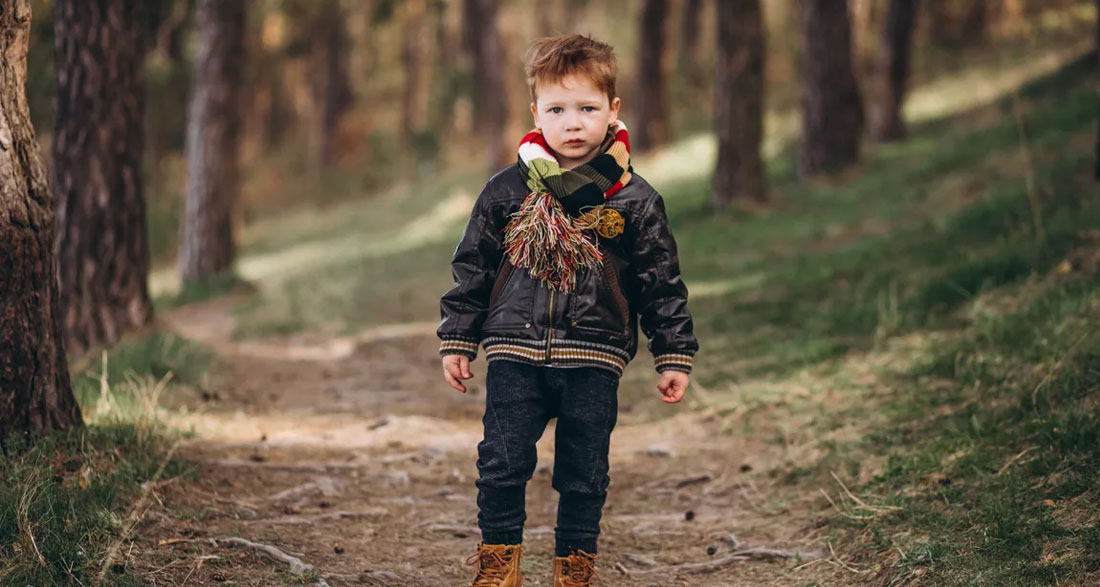
Branches rustled. I pushed them aside and saw him—a little boy, four or five, bare feet pressed into the damp dirt, thin pajama pants soaked, jacket unzipped, hair plastered to his forehead.
He shivered violently, cheeks streaked with dried tears, eyes wide and darting like he couldn’t trust the world. He wasn’t yelling. He was just… broken little sounds, like crying hurt too much.
My chest tightened. I knew that look. My daughter was autistic. When she got overwhelmed, she’d shut down just like this. Hands over ears, body trembling. I hadn’t seen that in years.
I dropped to one knee, careful not to scare him.
“Hey, buddy. You’re okay. I’m not gonna hurt you.”
He flinched, clamping his hands over his ears.
“Too loud, huh?” I murmured. “Okay… we’ll do this slowly.”
I sat on the cold dirt, leaving space. I slid my jacket closer. “You look cold. This jacket’s warmer than those pajamas. You can grab it if you want. No rush.”
He rocked slightly. His eyes darted, unsure.
“Can we try breathing?” I asked gently. “In… and out… slowly.” I demonstrated, loud and exaggerated. After a moment, I saw his chest try to match mine. Shaky. But it worked.
“That’s it. You’re doing great, kiddo.”
Slowly, one hand lowered. Then the other. Fingers crept to the jacket, pulling it around his shoulders, burying his face in the collar. That tiny trust hit me harder than any insult I’d heard in years.
“You’re safe,” I whispered. “I’ve got you.”
I called the gatehouse, then 911.
“Found a little boy on the walking path. Maybe five. Cold, not talking. I’m with him.”
Dispatch told me to keep him warm and stay put. So we sat there, frozen knees and all, as he nestled in my jacket. At one point, he reached out, touching my sleeve with two tiny fingers. Just resting them there. My throat burned.
“Name’s Harold,” I said. “You don’t have to talk. I’ll do the talking ’til your mom gets here.”
Minutes later, sirens wailed. Security arrived, then paramedics. They wrapped him in a foil blanket, checked him over, and listened to my story.
“Gate on the east side sticks sometimes,” I told them. “He probably wandered out.”
One nodded. “His name’s Micah. Mom’s at home freaking out.”
They carried him to the ambulance. Right before the doors closed, he twisted in the paramedic’s arms, looking for me. I raised my hand. His tiny fingers reached up in the air, like he wanted to tap my sleeve again. Then they were gone.
By noon, I learned the basics: Micah, five, mostly nonverbal, slipped out while his mom thought he was still in his room. Gate was half-open.
I finished my shift. Ate a can of soup in my storage room. Lay down on my cot. And then… pounding. Someone tried to kick my door in.
“OPEN UP! I KNOW YOU’RE IN THERE!”
I shot up. Fist pounding on metal.
“Hold on! I’m coming!” I shouted, fumbling the lock.
The door flew inward. Sweat-streaked woman. Hair a messy bun. Eyes wide. Breathing hard.
“Elena,” I recognized. Micah’s mom.
“You,” she snapped, jabbing a finger at me. “What did you do to my son?”
I blinked. “Your—Micah? He’s home, isn’t he? The paramedics said—”
“What did you do to my son?”
“Don’t lie to me!” she screamed. “Neighbors told me everything about you. They said you’re unstable. That you’ve been in prison. That you creep around at night. And then the police tell me my son was found near your route? What am I supposed to think? That you tried to kidnap him?”
Tears streaked her face.
“I— that’s not—” I started.
She shook with sobs.
“Ma’am, I understand you’re scared,” I said slowly, hands raised. “But I didn’t hurt your boy. I would never hurt any child. I found him.”
“You expect me to just believe that?”
“I found him in the bushes. Cold. Barefoot. Soaked. Not talking, just tiny sounds. I sat down, gave him my jacket, called for help, and waited. That’s it.”
She stared, trying to see through me.
“My neighbors said you’re… an unknown quantity,” she whispered, voice softer now.
“I lost my wife and daughter in a car crash. I’ve never been arrested. I’m just… quiet.”
Her expression softened slightly.
“My daughter was autistic,” I added. “When she shut down, she looked just like Micah did this morning. Same hands-over-ears, same overwhelmed look. I knew he wasn’t being ‘bad.’ He was scared.”
Her shoulders slumped.
“I would never take a child,” I said. “I know what losing a family feels like. I wouldn’t wish it on anyone.”
“Oh God,” she whispered. “What have I done?”
She cried again, quieter this time, less fury, more shame.
“You just… helped him,” I said.
She wiped her face. “I’m sorry. I let fear and gossip fill in the blanks. I saw ‘maintenance guy’ and rumors, and my brain did the rest.”
“It’s alright. Fear makes people jump to bad places,” I said.
She breathed shakily. “Micah kept tapping his wrist after he got home. Making that sound. I thought he was scared of whoever found him. Now I think… he was asking for you.”
My chest tightened. “He held my sleeve until the paramedics put him on the stretcher.”
She glanced past me, at the storage room. Cot. Tiny heater. Old photo of my wife and daughter.
“You live here?” she asked softly.
“Yeah. Cheapest spot in Ridgeview.”
“That’s not funny. Not right either.”
“Roof’s a roof,” I shrugged.
She hesitated. “Micah doesn’t let people in easily. He doesn’t talk. You… met him where he was. You did what even I struggle to do sometimes.”
She paused. “I know you’re ‘just the maintenance guy,’ but that doesn’t matter to him. Or to me. If you’re willing… I’d like you to be part of his routine. Come by sometimes. Walk with us. Say hi.”
I stared. “You want me around your kid… after all that?”
“Yes. Because now I know who you are. You sat in the dirt and kept my son safe.”
I looked away, blinking fast to hold back tears.
“I’d like that. A lot,” I said.
She smiled, tired but real. “I know who you are.”
“I’m Elena,” she said.
“Harold,” I replied. “Nice to meet you properly.”
Months later, a few evenings a week, I walk the path near their house. Sometimes Micah is already on the porch, rocking. When he sees me, he trots down the steps, stops in front of me, and taps my sleeve with two fingers.
“Hey, buddy,” I say. “You ready?”
We walk slowly. He shuffles through leaves, bumps into me, or holds my sleeve for a few steps. Elena walks with us, talking schedules, therapies, meltdown days. Sometimes she asks about my daughter. She doesn’t look away when my voice cracks.
One afternoon, she said, “People still gossip about you, you know.”
“I figured.”
“I correct them. Every time.”
Micah reached for my hand then. Not just my sleeve—my hand. Small fingers curling around mine.
I said nothing. Just kept walking.
For years, I was the shadow. The rumor. The warning.
Now, to one little boy and his mom, I’m something else.
For the first time in a long, long time… I don’t feel invisible.