

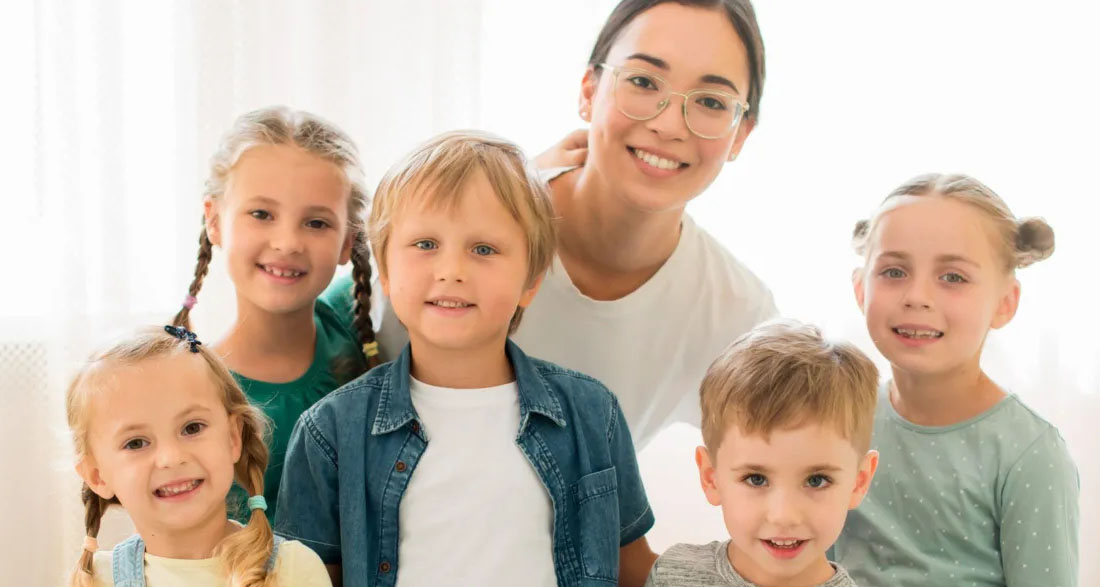
I thought adopting my late best friend’s four children was the hardest thing I’d ever do — until a stranger appeared at my door years later.
She looked me straight in the eye and said, “Your friend… wasn’t who she said she was.” Then she handed me a letter. That’s when I realized Rachel’s lies had returned, threatening everything we had built without her.
Rachel had been my best friend for as long as I could remember.
There wasn’t a single day I could pinpoint when we became inseparable. We just always were.
We sat next to each other in elementary school because our last names were close in the alphabet. In high school, we shared clothes, borrowed each other’s notes, and whispered about crushes in the hallways. In college, we shared tiny, terrible apartments and stories about even worse boyfriends.
By the time we had children, we shared calendars, carpool schedules, and endless lists of parenting hacks.
“This is it,” Rachel said one afternoon, standing in my kitchen with a baby on her hip and another tugging at her jeans. Her eyes glowed with that rare mix of exhaustion and wonder. “This is the part they don’t tell you about.”
“The noise?” I asked, smiling.
She laughed. “The love,” she said, her voice soft and awed. “It just keeps multiplying.”
I had two kids. Rachel had four. She was always tired, but there was a light in her that seemed real, a glow that came from loving her kids more than anything else in the world. Or at least, that’s what I believed.
Twenty years of friendship make you think you know someone. You think friendship means transparency. But now I wonder how many secrets Rachel carried that I never saw, how many truths she almost told me but never did.
Everything changed shortly after she gave birth to her fourth child, a tiny girl named Rebecca. Her pregnancy had been rough. The last half of it was spent mostly on bed rest.
Barely a month after they brought Becca home, Rachel’s husband was in a car accident. I was folding laundry when my phone rang.
“I need you,” Rachel said, her voice tight, trembling.
“Where are you? What happened?”
“Come now,” she said, almost panicked.
When I got to the hospital, she was sitting in a plastic chair, cradling the baby carrier on her knees. Her eyes were red, brimming with tears.
“He’s gone,” she whispered. “Just like that.”
I didn’t know what to say, so I just held her.
The funeral was on a rainy Saturday. Water poured from the sky as Rachel stood surrounded by her children, small hands gripping her coat and each other.
“I don’t know how to do this alone,” she whispered afterward.
“You won’t be alone. I’m right here,” I said.
Not long after that, the doctor called with devastating news: Rachel had cancer.
“I don’t have time for this,” she said bitterly. “I just got through one nightmare.”
She tried to stay strong for the kids, joking about wigs and insisting on school drop-offs even when she could barely stand. I went over every morning.
“Rest,” I told her. “I’ve got them.”
“You already have your own,” she said weakly.
“So? They’re all just kids,” I said, shrugging.
There were moments in those months when she looked at me as if she wanted to tell me something—then she’d stop, frown, and stare off into the distance. Once, she admitted softly, “You’re the best friend I’ve ever had. You know that, right?”
“Right back at you,” I said.
“I’m not sure I am… a good friend, that is,” she whispered.
I thought she felt guilty about leaning on me so much, but now I know I was wrong.
Six months later, she was dying.
“I need you to listen,” she said one evening, barely above a whisper.
“I’m here,” I said.
“Promise me you’ll take my kids, please. There’s nobody else. I don’t want them to be split up. They’ve already lost too much…”
“I’ll take them,” I said firmly. “And I’ll treat them like my own.”
“You’re the only one I trust,” she said.
Those words sank into me like stones, heavy but precious.
“Rebecca… keep a close eye on her, okay?” she added, her voice faint but intense.
“Of course,” I said, thinking she meant the baby. But those words would come back to haunt me years later.
When the time came, keeping Rachel’s promise wasn’t hard. She and her husband had no close family willing to take the children. My husband didn’t hesitate either.
Overnight, our family doubled. The house felt smaller, louder, messier, but it also felt fuller in a way I couldn’t explain.
Weeks became months, and the children, once strangers to each other, became inseparable. My husband and I loved them all as our own, and after a few years, life finally felt stable. We thought we had made it.
Then, one day, there was a knock at the door.
A woman stood on the porch. Well-dressed, younger than me by a few years, her hair pulled back tight. She wore a gray coat that looked expensive, but it was her eyes that struck me—they were red-rimmed, like she’d been crying.
“You’re Rachel’s friend,” she said immediately. “The one who adopted her four children?”
I nodded slowly, feeling a chill.
“I know we don’t know each other, but I knew Rachel, and I need to tell you the truth. I’ve been looking for you a long time.”
“What truth?” I asked cautiously.
She handed me an envelope. “She wasn’t who she claimed to be. You need to read this letter from her.”
I stood there, half in the doorway, gripping the letter. Rachel’s handwriting was unmistakable. I unfolded it, and reading her words felt like forgetting how to breathe.
I had rewritten the story in my head so many times, trying to make sense of it all. But this letter—this was something else.
“You came to me when you were pregnant and barely holding yourself together,” it read. “You told me you loved your baby, but you were afraid of what would happen if you tried to raise her the way things were then.
When I offered to adopt her, it wasn’t because I wanted to take something from you. It was because I thought I could hold things steady until you could breathe again. We decided to keep it private.
You didn’t want questions. I didn’t want explanations. I told people I was pregnant because it felt easier than telling the truth. And because I believed it protected all of us.”
My fingers trembled. One of Rachel’s children wasn’t hers? And I had never known.
“So she wasn’t pregnant?” I asked aloud.
“No. Not with my girl,” the woman said, stepping closer. “Now you know the truth. It’s time to give her back.”
I stepped sideways instinctively, blocking the door.
“Rachel adopted her. I adopted her. That doesn’t change just because you want it to.”
“It’s what she promised me!” the woman said, pointing at the letter. “It’s all here!”
I forced myself to read more, though part of me wanted to tear the letter apart and pretend this woman had never appeared.
“I told you once that we would talk again when things were better for you,” the letter continued.
“We would figure it out. I don’t know if that was kindness or cowardice, but it gave you hope. I’m sorry for that. All I can ask is that you think about her first—not about what was lost, not about what feels unfinished, but about the life she has now.”
“I turned my life around. I can take care of her now! I swear it!” the woman said, her lip trembling.
“Her life is here, with her family. You can’t take that from her,” I said calmly, though my heart pounded.
“She lied to me,” I muttered.
“Yes,” the woman said quietly. “She lied to everyone.”
“But she didn’t steal your child,” I said. “And there’s nothing here where she promised to give her back.”
“You can’t just—”
“Watch me,” I said firmly.
The woman lunged forward and snatched the letter. “I’ll be back. Next time, you won’t stop me from claiming what’s mine.”
She walked down the steps. I leaned my forehead against the door, shaking, my chest tight.
Rachel had lied. A huge secret had been hidden, and now I would have to dig through her things and consult a lawyer—just to be safe.
A year later, the courts confirmed what I had known all along: adoptions can’t be undone just because someone changes their mind. Becca was mine. Her biological mother had no claim.
I walked down the courthouse steps knowing our family was safe. Nobody could take any of my children from me.
I had kept my promise to Rachel.
And I had kept my family whole.