

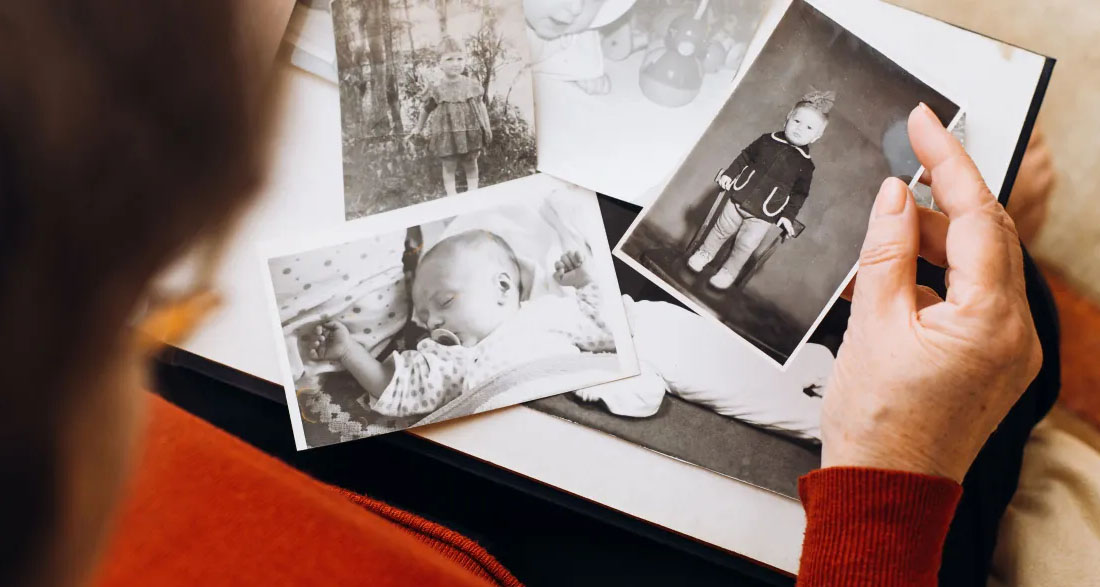
I found the photograph by accident, wedged deep in the back of my late mother’s old album, as if someone had carefully hidden it there and hoped it would never be found. It slipped out when I lifted the album, fluttered to the floor, and landed face down at my feet.
At first, I almost ignored it. But something made me bend down and pick it up.
The moment I turned it over, my breath caught so hard it felt like my chest forgot how to work.
There were two little girls in the photo.
One of them was me.
I recognized myself instantly. I was two years old, wearing a light-colored dress my mother loved, my hair thin and messy the way it always was in my toddler photos. But standing right beside me was another little girl, a bit taller, maybe four or five years old.
She had my eyes.
My nose.
My mouth.
My face.
Not similar. Not close. Identical.
She looked exactly like me.
My name is Anna, and I’m 50 years old. My mother had just passed away at 85, and I was alone in her house, surrounded by the quiet weight of a lifetime. My father had died when I was very young, so it had always been just the two of us. After he died, my mother became everything to me—my provider, my protector, my anchor in the world.
She worked hard, kept our life simple, and never talked much about the past. I never questioned it. I didn’t know there were questions to ask.
After the funeral, I took a week off work and came back to her house alone. I left my husband and children at home because I knew this would be hard. I needed time to go through her things, room by room, memory by memory.
For three days, I worked through bedrooms and closets. Every object held a story. Every story reminded me of how small and quiet our world had been. Grief has a way of sneaking up on you when it’s wrapped in nostalgia.
On the fourth day, I climbed into the attic. The ladder creaked under my weight, dust floated in the air, and the single light bulb flickered before finally settling. That’s where I found the family photo albums, stacked inside an old cardboard box.
I carried them downstairs and sat on the floor, opening them one by one. Page after page of my childhood stared back at me—birthday parties, school photos, summer days I barely remembered but somehow still felt deep in my chest.
More than once, my eyes filled with tears.
Then I turned another page, and that’s when the loose photograph slipped out.
It hadn’t been attached. It hadn’t been meant to be seen.
I picked it up with shaking hands.
Two little girls. And only one of them was me.
I flipped the photo over and saw my mother’s handwriting.
“Anna and Lily, 1978.”
My chest tightened.
I was Anna. I knew that. But I had never heard the name Lily. Not once. Not in my entire life.
The date meant I was two years old. The other girl was older, maybe four or five. And she looked exactly like me.
I went back through every album again, slowly, carefully, page by page. There were countless pictures of me. But there wasn’t a single other photo of that girl.
No Lily.
Just one photograph, hidden at the very back, and a name that should have meant something—but didn’t.
My mind ran through every possible explanation. A neighbor’s child. A distant cousin. A family friend. But none of it made sense. That girl wasn’t just someone who looked like me.
She was part of my childhood.
And I had no memory of her at all.
The thought I had been pushing away finally rose to the surface.
What if she was my sister?
And if she was, how could I not remember her?
I searched my memory as far back as I could reach. There had never been another child in our house. No second bed. No extra toys. No stories about “when you girls were little.”
It had always been just my mom and me.
That’s when I thought of my mother’s sister, Margaret.
She lived less than two hours away, and we hadn’t spoken in years. All I knew was that she and my mother never got along. Their conversations were rare, short, and tense. After my father died, whatever fragile connection they had seemed to disappear completely.
But now, suddenly, she mattered.
Margaret was the only person left who might know something. She was the only one who had been there before everything went quiet.
I didn’t call her. I didn’t want excuses. I didn’t want her to say she was busy or that it wasn’t a good time.
I wanted the truth.
So I got in my car, placed the photograph on the passenger seat, and drove straight to her house without warning.
I parked just before sunset and sat there for a moment, staring at the photo, wondering if I was about to open a door that could never be closed again.
Then I got out of the car and knocked.
It took longer than I expected. When the door finally opened, my aunt stood there leaning heavily on a cane. Her hair was completely gray, her face thin and lined, like someone who had carried heavy secrets for a very long time.
She stared at me for a second. Then she said, “Anna.”
Not surprised. Just tired.
“Hi,” I said softly.
She stepped aside and let me in.
We stood in the entryway in silence. My heart was pounding. Without saying a word, I reached into my bag and handed her the photograph.
The moment she saw it, her hand flew to her mouth. She sank into the nearest chair, the photo shaking in her fingers, tears filling her eyes instantly.
“Oh,” she whispered. “I was afraid this day would come like this.”
She looked up at me, tears streaming down her face. “I’m so sorry, dear. I’m sorry you had to find out this way. And I’m sorry you didn’t know the truth your whole life.”
My heart raced. “Who is she?” I asked. “And why have I never heard her name?”
Margaret closed her eyes for a long moment, like she was bracing herself. Then she nodded toward the kitchen.
“Sit down,” she said quietly. “You deserve to know everything.”
We moved to the kitchen table in silence. She folded the photograph carefully and placed it between us.
“What I’m about to tell you,” she said, her voice breaking, “is something your mother spent her entire life trying to bury. Not because she didn’t love you, but because the truth hurt too much.”
She reached for my hand.
“Your father was unfaithful to your mother,” she said. “For years. Not with strangers. With me.”
It felt like all the air left the room.
Margaret told me everything in a steady voice, as if she had told this story to herself a thousand times.
“It started quietly,” she said. “Hidden behind family dinners and holidays. Then I got pregnant.”
She told everyone the man had disappeared. No name. No details. Just absence.
Soon after, my parents got married. Then I was born.
“For a while, the lie held,” she said. “But as Lily grew, the resemblance became impossible to ignore. Your mother didn’t need proof. She just knew.”
There were arguments. Screaming. Doors slamming hard enough to shake the walls.
My mother had been betrayed twice—by her husband and by her sister.
When my father died, whatever fragile connection remained was gone.
Margaret raised her daughter, Lily, alone. Lily eventually left for college, built a life in another state, and moved forward.
“She doesn’t know about you,” Margaret said quietly. “Just like you never knew about her.”
For a while, I did nothing. I let the truth settle. Then I knew one thing: if I was going to find my sister, it had to be done carefully.
A week later, I called Margaret.
“I need to ask you something,” I said. “And you don’t have to say yes.”
She sighed. “I wondered when you’d call.”
I told her I wanted to meet her daughter. Not to disrupt her life. Just to be honest.
“She doesn’t know,” Margaret said. “I thought I was protecting her.”
“I understand,” I said.
After a long pause, she whispered, “Let me talk to her first.”
A few days later, Margaret called back. “She wants to hear from you. She’s open.”
She gave me Lily’s number. I stared at it for a long time before I typed a message. I kept it short and honest. I told her who I was. What I’d learned. That I didn’t expect anything—only a conversation.
She replied the next evening. She had questions. So many questions. And she said she had always felt like something in her family story didn’t add up.
We talked that weekend. It wasn’t easy, but it was real.
Calls turned into longer conversations. We compared childhood memories that overlapped in strange, painful ways.
When we finally met in person, even we were startled by the resemblance.
But what mattered more was how natural it felt.
Over time, we stopped feeling like strangers. We started feeling like sisters who had simply met late.
Finding Lily didn’t erase the past. It didn’t fix what was broken before we were born. But it gave me something real in the present.
At 50 years old, I didn’t just uncover a secret.
I gained a sister.
Now, when I look at that photograph of two little girls standing side by side, I don’t just see a mystery. I see the beginning of something I never knew I lost—and the chance to make it whole again.
Truth doesn’t always heal everything. But it gives you the chance to try.
And sometimes, that chance is everything.