

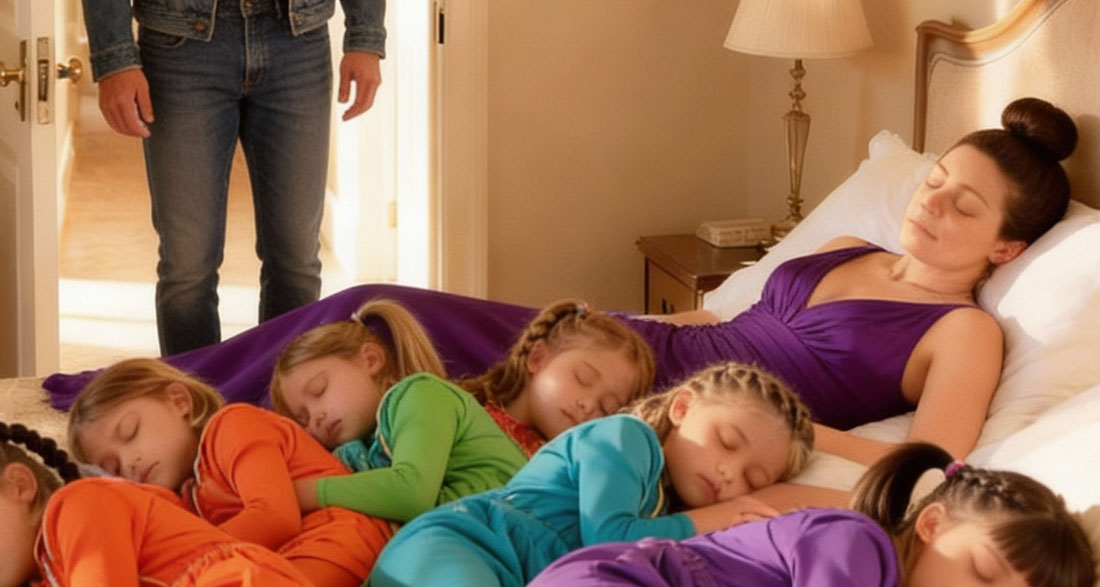
For nearly three weeks, the Whitaker estate in the quiet hills above San Diego had been quietly blacklisted by every agency. No official warning had ever been given. Nobody said the place was haunted, or cursed, or dangerous.
They didn’t have to. Anyone who stepped inside left changed. Some walked out in tears, others screaming. One woman barricaded herself in the laundry room, refusing to come out until security dragged her away.
The last one had run barefoot down the long driveway at sunrise, her hair dripping with green paint, screaming that the children were possessed and that the walls whispered while people slept.
Jonathan Whitaker, standing behind the tall glass doors of his office, watched the taxi disappear down the winding road.
He was thirty-seven, the founder of a booming cybersecurity company, a man whose face graced magazines next to words like visionary and innovator. But none of that mattered now.
Not when the sharp crash of glass echoed from somewhere upstairs. The house—immense, elegant, almost regal—felt suffocating, as if it were closing in on him.
Across from his desk hung a framed photograph, taken four years ago. Maribel, his wife, knelt in the sand, laughing as the sun kissed her hair. Around her, their six daughters—sunburned, messy, alive—posed in chaotic perfection. Jonathan lifted his hand, tracing her smile with trembling fingertips.
“I’m failing them,” he whispered, voice barely more than a breath.
His phone rang. Steven Lowell, his operations manager, spoke carefully, the kind of carefulness that comes when people are afraid of making grief worse.
“Sir… I’ve called every agency. No licensed nanny will take the job. Legal told me to stop trying.”
Jonathan exhaled slowly. “Then… we don’t hire a nanny.”
Steven hesitated. “There’s… one last option. A residential cleaner. No childcare duties on record. She might… she might work.”
Jonathan looked out over the backyard. Toys lay broken among dead plants. Patio chairs were overturned. The swimming pool glimmered like a dark mirror, reflecting a life nobody wanted to face.
“Hire whoever says yes,” he said.
Across town, in a cramped apartment near National City, Nora Delgado laced up her worn sneakers and shoved her psychology textbooks into a backpack.
At twenty-six, she worked six days a week cleaning houses and took night classes in child trauma. Friends, dating—she had no time, and she didn’t need it. Her goal was clear: finish school, get licensed, help children like the one she had once been.
When she was seventeen, her younger brother had died in a house fire. Since then, fear had no power over her. She had already survived the worst kind of silence—the kind that lingers after screaming stops.
Her phone buzzed. Her supervisor’s voice was tight, urgent. “Emergency placement. Private estate in La Jolla. Immediate start. Triple pay.”
Nora’s eyes flicked to the tuition bill taped to her fridge. “Send me the address,” she said without hesitation.
The Whitaker house was breathtaking, but cold. Glass walls, stone floors, perfect lines, not a fingerprint out of place. The security guard at the gate didn’t smile.
“Good luck,” he muttered. “You’ll need it.”
Jonathan met her at the door, eyes ringed with exhaustion, shirt rumpled. “This is strictly cleaning,” he warned. “My daughters… they’re grieving. I can’t promise calm.”
A loud crash from upstairs was followed by high-pitched laughter, sharp and eerie.
Nora didn’t flinch. “I’m not afraid of grief,” she said simply.
Six girls lined the staircase behind him.
Hazel, twelve, stood straight-backed, wary. Brooke, ten, fidgeted nervously. Ivy, nine, avoided his eyes. June, eight, pale and quiet, leaned against the railing. The twins, Cora and Mae, six, grinned too wide, testing the limits. At the bottom, little Lena, three, clutched a stuffed rabbit missing an ear.
“I’m Nora,” she said, calm. “I’m here to clean.”
Hazel tilted her head. “You’re number thirty-eight,” she said.
Nora gave a faint smile. “Then I’ll start with the kitchen.”
Inside, the house was immaculate and heavy at the same time.
Dustless, yet thick with memory. Every wall carried Maribel’s presence: cooking, holding newborns, laughing with all six girls on her lap. In one photo, she lay in a hospital bed, pale but smiling. Grief here wasn’t hidden—it was furniture, wallpaper, and air.
Nora found a note inside a kitchen drawer, written in looping cursive: Banana pancakes shaped like animals. Saturday morning tradition. She decided to make them, though she expected no one to eat.
When she returned to the dining room, Lena was there, watching, wide-eyed. It was as if she had conjured her mother from thin air.
The twins tried to scare her with a rubber scorpion in the mop bucket. Nora picked it up, inspected it, and said, “Nice detail. But fear needs a story. You’ll have to do better next time.” Then she set it neatly aside and continued cleaning.
When June wet the bed, expecting a harsh scolding, Nora brought a towel. “Fear confuses the body. It happens to everyone. Let’s clean it up together.” June nodded, tearful but steady.
One afternoon, Nora found Ivy hyperventilating in a corner, hands clamped over her ears. Calmly, Nora crouched beside her, describing the room, the colors, her breathing. Slowly, Ivy’s hands lowered, her breaths steadied.
“How do you know this?” Ivy whispered.
“Because someone once helped me,” Nora said.
Days passed quietly. The house softened. Laughter lost its edge. Footsteps no longer made the girls run. They followed Nora, asked questions, offered small hands to help. The twins competed over folding towels perfectly. Brooke timidly played the piano. Hazel watched, protective and careful, carrying too much for her age.
Jonathan began coming home earlier, watching silently as the girls lived, breathed, and slowly began to heal.
One night, he stopped Nora in the hall. “What did you do that I couldn’t?”
“I stayed,” she said. “I didn’t ask them to heal.”
Jonathan nodded, unsure how to respond.
Two weeks later, the illusion shattered. Hazel tried to overdose on her mother’s sleeping pills. Nora found her collapsed in the upstairs bathroom. The night blurred—sirens, flashing ambulance lights, paramedics.
Jonathan sat at the hospital, hunched in a plastic chair, hands white-knuckled. For the first time, he cried—not polite tears, but the kind that rips open the soul.
Nora sat beside him, silent, steady. She didn’t say it would be okay—he wouldn’t have believed her—but she stayed. That was enough.
Hazel survived. Days later, she asked for Nora. Healing didn’t happen fast, but it began there: in the fluorescent hospital light, between a broken father and a woman who refused to look away.
Months later, the house breathed again. Tutors arrived. School restarted. Grief still visited, but it now had room to stretch, not suffocate. Nora taught them to plant herbs in pots, and soon the backyard bloomed with life. Jonathan found himself laughing, the sound strange but real.
On Nora’s graduation day, the Whitakers filled the front row. The twins waved signs: We love you, Miss Nora! Lena clapped wildly.
Under a jacaranda tree afterward, Jonathan spoke. “We want to open a counseling center—for grieving kids. In Maribel’s name. We’d like you to help run it.”
Nora’s throat tightened. “I… I don’t know what to say.”
“You already did,” Hazel said softly. “You didn’t replace Mom. You helped us survive losing her.”
Nora cried—openly, freely, surrounded by those who had once been strangers.
“That’s enough,” she said through tears. “That’s more than enough.”
Years later, whispers still circled the Whitaker estate. A house that had driven nannies mad now pulsed with life. Laughter, piano music, and bedtime stories replaced screams. Grief lingered, but love lasted longer.